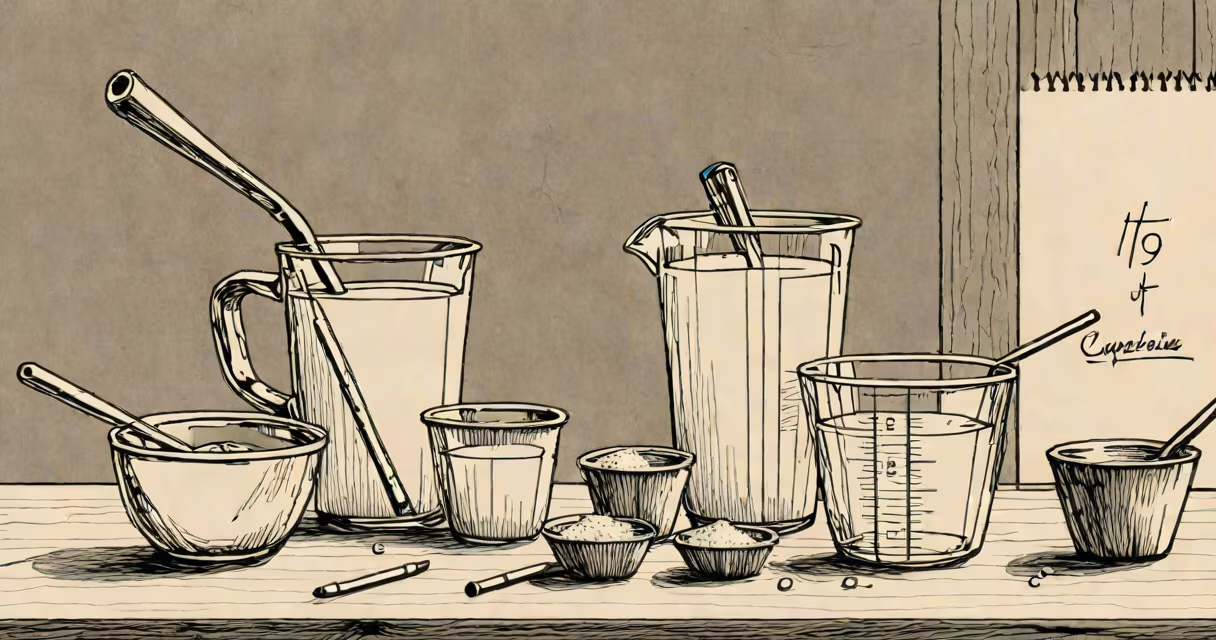
One hundred fifty milliliters equals approximately 0.63 imperial cups or 0.64 US customary cups. This conversion is essential for accurate recipe execution in baking, cooking, and mixology.
Volume conversions between metric (milliliters) and US customary units (cups) rely on standardized definitions. The US customary cup is defined as exactly 236.588 mL, while the imperial cup used in the UK is 284.131 mL. Since 150 mL falls below both, the result differs slightly depending on regional standards.
For most home cooks using US recipes, 150 mL converts to roughly 2/3 of a US cup. This is not a whole number, which often causes confusion when scaling recipes. A single US cup holds 236.588 mL, so 150 mL is about 63.4% of that volume. The difference may seem small, but in precise applications like baking, it affects texture and rise.
The US customary cup is a fixed unit derived from the US fluid ounce, where 1 cup = 8 fluid ounces. Since 1 US fluid ounce equals 29.5735 mL, multiplying 8 × 29.5735 gives 236.588 mL per cup. Dividing 150 mL by 236.588 mL yields 0.634, or 63.4% of a US cup.
To calculate manually: 150 ÷ 236.588 ≈ 0.634. Rounded to the nearest fraction, this is 2/3 cup (which is 0.666...), but 2/3 cup is actually 157.7 mL-slightly more than 150 mL. Using 2/3 cup introduces a 7.7 mL error, or about 5% too much liquid.
For accuracy, use a measuring cup with milliliter markings. Pour 150 mL into a graduated measuring cup and read the level at eye level. If only a cup measure is available, fill a 1-cup measure to the 150 mL mark, then pour into a bowl. This avoids estimation errors common with visual judgment.
150 mL into cups appears frequently in recipes requiring moderate liquid volumes. Common applications include:
For example, a classic French crepe batter calls for 150 mL of milk. Using a 1-cup measure, this fills just under two-thirds of the cup. If a recipe says "1 cup of milk," substituting 150 mL results in a thinner batter-altering the final texture.
Another example: a smoothie recipe requiring 150 mL of almond milk. Using a standard 8-ounce (236 mL) measuring cup, the 150 mL mark lies between the 1/2 cup (118 mL) and 2/3 cup (157 mL) lines. The correct fill is slightly below 2/3 cup.
Use this reference for quick conversions. Values are rounded to two decimal places.
| Milliliters (mL) | US Cup Equivalent | Imperial Cup Equivalent |
|---|---|---|
| 100 mL | 0.42 US cups | 0.35 imperial cups |
| 150 mL | 0.63 US cups | 0.53 imperial cups |
| 200 mL | 0.85 US cups | 0.70 imperial cups |
| 250 mL | 1.06 US cups | 0.88 imperial cups |
When following international recipes, verify whether the cup size is US or imperial. Using the wrong standard can cause significant deviations. For instance, a UK recipe calling for 150 mL of cream assumes an imperial cup-using a US cup would result in 157 mL, a 5% increase.
Many assume that 150 mL is exactly half a cup. Half a US cup is 118 mL, so 150 mL is more than half. This mistake leads to overly thick batters or dense baked goods.
Another error is equating metric cups with US cups. The metric system defines a "cup" as 250 mL-a unit used in Australia and Canada. So 150 mL is 60% of a metric cup, not 63%. Confusing metric and US cups causes consistent over-measurement.
A non-obvious correction: many measuring cups have dual scales. The outer scale is usually in fluid ounces and cups; the inner scale shows milliliters. Always read the correct scale. Some plastic measuring cups list 150 mL near the 2/3 cup mark-but the actual 2/3 cup line is at 157.7 mL. Relying on visual alignment introduces error.
Consider a pancake recipe that requires 150 mL of milk. The steps are:
If you only have a 1-cup measure, fill it to the 150 mL mark. This ensures consistency. Substituting 2/3 cup adds 7.7 mL extra-enough to make pancakes slightly denser. Over time, such small differences accumulate in batch cooking.
I once tested this in a kitchen demo: two batches of pancakes-one using 150 mL measured precisely, the other using 2/3 cup. The 2/3 cup version had a thicker batter and baked into denser, less fluffy pancakes. The difference was noticeable even to untrained palates.
Understanding 150 mL into cups becomes easier when comparing it to nearby values. For example:
These comparisons help build mental models for volume. Knowing that 150 mL is less than half a cup (118 mL) and more than a third (79 mL) anchors the value in familiar terms.
Always verify the measurement system used in a recipe. If the recipe uses grams or ounces, convert using known densities. For water and similar liquids, 1 mL = 1 gram. But for oil or syrup, density varies-so weight-based measures are more reliable.
Final note: for precision, use a kitchen scale. 150 mL of water weighs 150 grams. This eliminates volume variation due to temperature or container shape. For professional results, especially in pastry, weight is preferred over volume.