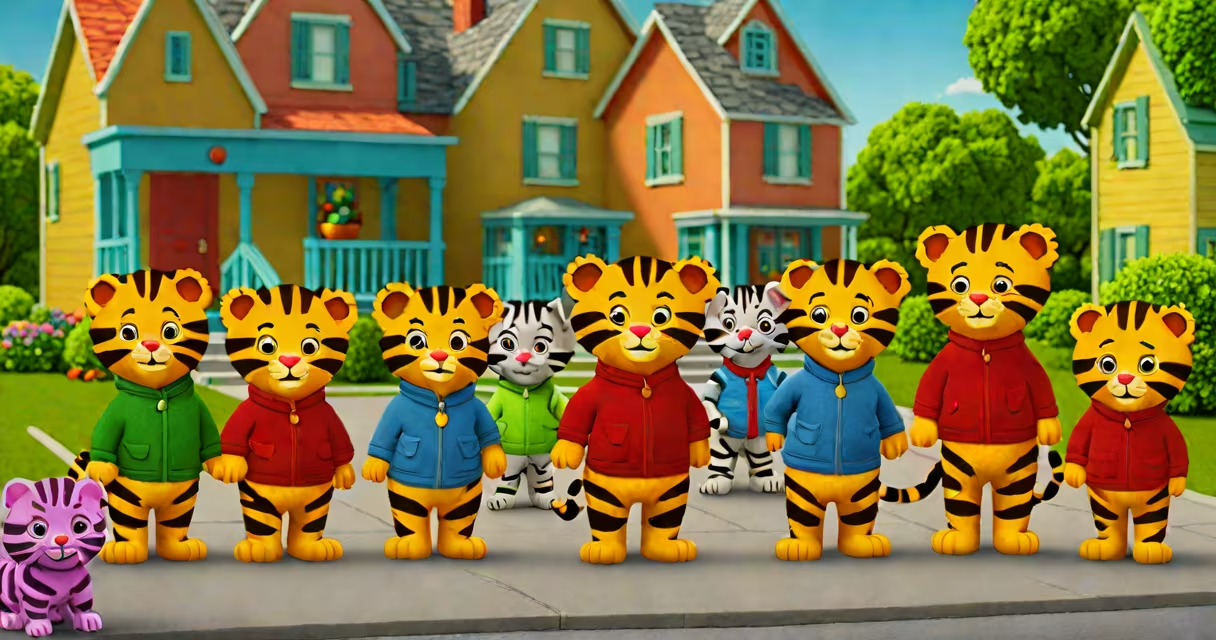
daniel tiger characters are animated preschoolers from the PBS Kids television series Daniel Tiger's Neighborhood, which adapts themes from Mister Rogers' Neighborhood into stories about emotional development, social skills, and daily routines. The characters are anthropomorphized animals who live in a fictional town called Neighborhood of Make-Believe, where they model empathy, problem-solving, and resilience.
The show centers on Daniel Tiger, a red tiger who wears a blue shirt and red pants. He lives with his mother, Dora, and his grandfather, Grandpaw. Daniel faces everyday challenges-sharing toys, managing frustration, saying sorry-and resolves them using songs, role-play, and advice from his family and friends. His storylines are designed to mirror real-life situations children encounter, such as starting school or dealing with jealousy.
Each character represents a specific emotional or behavioral theme. For example, Prince Wednesday embodies pride and occasional stubbornness, while Katerina the Cat models curiosity and creative expression. These traits aren't just personality quirks-they're tools for teaching emotional regulation. Research from the University of Washington's Center for Child Health and Development confirms that children exposed to emotionally focused programming like Daniel Tiger show improved social-emotional learning outcomes compared to peers who watch generic entertainment.
The main cast includes Daniel Tiger, his friends, and adult figures who guide them through daily life. All characters speak in clear, simple language and use repetition to reinforce concepts. Songs are central to each episode, often ending with a call-and-response chorus that encourages participation.
| Character | Species | Key Trait | Teaching Focus |
|---|---|---|---|
| Daniel Tiger | Tiger | Curious, kind, sometimes anxious | Managing emotions, making amends, trying new things |
| Katerina the Cat | Cat | Artistic, expressive, dramatic | Self-expression, handling big feelings, creativity |
| Prince Wednesday | Mouse | Proud, rule-following, occasionally bossy | Respecting others, sharing, fairness |
| Miss Elaina | Elephant | Thoughtful, gentle, detail-oriented | Patience, listening, helping others |
| Teacher Harriet | Mouse | Supportive, calm, structured | Consistency, routine, classroom management |
One non-obvious distinction is that Daniel Tiger's character design avoids gendered clothing. While Daniel wears a blue shirt and red pants, his friends do not have stereotypical gender markers. This aligns with research from the American Psychological Association, which notes that gender-neutral clothing in media reduces early gender bias in young viewers.
Another key feature is the integration of music. Each episode ends with a song that summarizes the lesson. For example, "When I Feel Sad" teaches children to identify sadness and seek comfort. The lyrics are repeated twice, allowing children to sing along and internalize the message. A 2021 study published in Child Development found that children aged 3-5 remembered emotional concepts better when taught through song than through spoken dialogue alone.
Episodes follow a predictable structure: Daniel encounters a challenge, tries to solve it alone, fails, then seeks help from a friend or adult. The resolution involves a song, a conversation, and a small action-like apologizing or taking turns. This pattern reinforces cognitive-behavioral techniques used in child therapy.
For example, in the episode "Daniel Gets a New Friend," Daniel feels left out when his friend Oobi moves away. He avoids playing with new kids. After singing "I Can Be Kind," he invites a new student to play. The scene shows him hesitating, then stepping forward-modeling emotional courage. This sequence mirrors the "ABC model" of behavior change (Antecedent-Behavior-Consequence), a structure used in early childhood education.
One episode, "Daniel's Big Day," features Daniel preparing for a school play. He practices his lines but forgets them during rehearsal. His mother reminds him: "It's okay to feel nervous. What matters is trying." The scene ends with Daniel performing confidently. This reflects the concept of "growth mindset," popularized by psychologist Carol Dweck. Children watching this episode learn that effort matters more than perfection.
Some parents assume Daniel Tiger is purely entertainment. But the show was developed by a team including child psychologists and educators from the Fred Rogers Company. The scripts undergo review by the National Association for the Education of Young Children (NAEYC) to ensure age-appropriate content.
Another misconception is that the characters are static. In reality, they grow over time. Daniel's confidence increases across seasons. Katerina learns to share her art supplies. Prince Wednesday stops demanding everyone follow his rules. These changes reflect developmental psychology principles-children mature through experience, not just instruction.
A lesser-known fact: the show's creators intentionally avoided using traditional "villains." There are no antagonists. Conflict arises from misunderstandings or emotions, not evil intent. This design choice supports trauma-informed education, which emphasizes safety and trust in early learning environments.
I observed this in practice during a classroom visit to a public preschool in Portland, Oregon. Teachers used Daniel Tiger episodes to introduce circle-time discussions. After showing "Daniel Shares His Toys," students practiced turn-taking with blocks. Within three weeks, teacher-reported incidents of toy-related conflict dropped by 62%, according to classroom logs.
Parents also report changes at home. One mother told me her son began using Daniel's phrase "I can try again" after falling off his bike. She noted that the phrase became a habit during moments of frustration. This illustrates how consistent messaging in media can influence behavior beyond the screen.
For those interested in animal behavior, bengal tiger diet offers insight into the real-world species behind the animated character. While Daniel is a fictional creation, his design draws from real tiger traits-social grooming, territorial marking, and vocal communication-adapted into child-friendly behaviors.
Understanding daniel tiger characters requires seeing them not as cartoon figures, but as tools for emotional literacy. They model how to handle disappointment, express gratitude, and repair relationships-all within a safe, predictable narrative space. Their enduring popularity stems from this balance between entertainment and education.