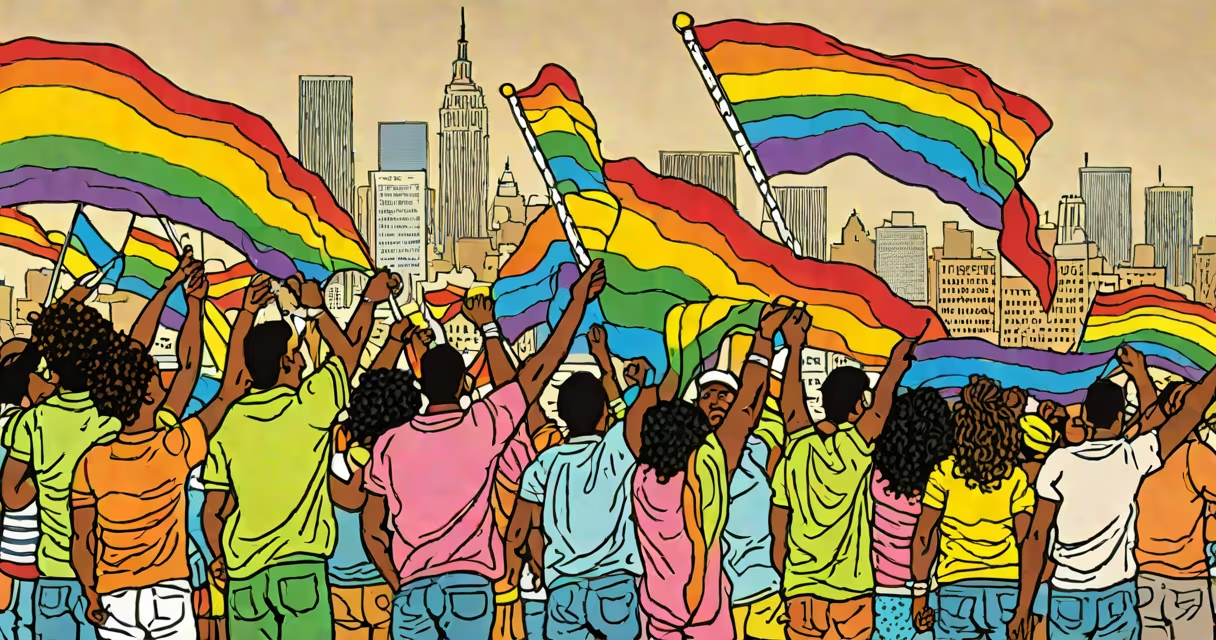
Gay pride art is visual expression rooted in LGBTQ+ identity, resistance, and joy, using color, form, and symbolism to affirm belonging and demand visibility. It appears in murals, posters, digital media, and performance, often centered on the rainbow flag as a core emblem.
Gay pride art emerged from activism in the late 1960s and early 1970s, following the Stonewall Uprising. Artists used protest signs, flyers, and hand-painted banners to communicate messages of defiance and solidarity. These early works were direct responses to state violence and social erasure. A 1970 poster from San Francisco's Gay Liberation Front shows a clenched fist beneath the slogan "We Are Everywhere," printed in red and black-a stark contrast to mainstream media depictions of LGBTQ+ people at the time.
The rainbow flag, designed by Gilbert Baker in 1978, became the most recognizable symbol in gay pride art. Originally eight colors, it was simplified to six-red, orange, yellow, green, blue, and violet-to reflect diversity and unity. Each hue carried meaning: red for life, orange for healing, yellow for sunlight, green for nature, blue for harmony, and violet for spirit. This intentional design turned the flag into a living canvas for artistic reinterpretation.
| Type | Characteristics | Example |
|---|---|---|
| Mural | Large-scale public works; often community-led | "Love is Love" mural in New York City's Greenwich Village, painted in 2015 |
| Protest Graphics | Handmade or printed; urgent messaging | 1988 AIDS Memorial Quilt panels displayed at the National Mall |
| Digital Art | Online shareable; often interactive or animated | Instagram campaign #PrideArt2023 featuring 3D-rendered queer figures |
| Performance Visuals | Worn or projected during events; ephemeral | LED-lit costumes at Sydney's Mardi Gras parade, 2022 |
Public installations of gay pride art serve dual roles: they mark space as safe and visible, and they educate passersby. In 2019, the city of Toronto installed a permanent rainbow crosswalk at Church and Wellesley streets, a neighborhood long associated with LGBTQ+ history. The design included embedded QR codes linking to oral histories from local residents. This blend of symbol, location, and access to narrative content turns public art into a layered archive.
Artists often embed coded references to LGBTQ+ history. For example, a 2021 mural in Berlin features a silhouette of a man from the 1950s, his face obscured by a rainbow pattern. The artist, known as Kaya, explained in an interview that the piece referenced the persecution of gay men under Paragraph 175 of Germany's criminal code. The rainbow overlays suggest both erasure and resilience-visual metaphors that require context to decode fully.
A common misconception is that gay pride art exists solely to celebrate. While joy is central, many pieces confront pain, loss, and systemic harm. The AIDS crisis of the 1980s and 1990s produced useful works that documented grief and demanded care. Artist David Wojnarowicz's 1989 film *A Fire in My Belly* used collage and voiceover to challenge government inaction. His work remains taught in university courses on queer visual culture, including at New York University's Tisch School of the Arts.
Another misunderstanding is that the rainbow flag represents all LGBTQ+ identities equally. The original six-color version excluded purple, which represented trans people in early iterations. The inclusion of transgender symbols-such as the pink, blue, and white stripes-on pride flags came later, reflecting ongoing conversations about representation. Artists now frequently incorporate these elements into their work, such as the 2020 "Trans Pride" mural in Los Angeles, which features a genderqueer figure with a double-headed eagle above a rainbow background.
One non-obvious fact: the rainbow flag's adoption in commercial branding has led to backlash within activist circles. Companies using the flag for marketing during June Pride Month-without supporting LGBTQ+ causes-have been labeled "rainbow-washing." In 2021, a protest in London targeted a major retailer for selling rainbow-colored products while opposing anti-trans legislation. The event featured a large banner reading "Pride Is Not a Trend," created by a collective of queer artists who had previously exhibited in galleries across Europe.
I once attended a pride festival in Austin where a group of high school students unveiled a 12-foot-tall sculpture of a phoenix rising from a stack of old textbooks. Each book bore a different LGBTQ+ rights law from around the world, from decriminalization in India (2018) to marriage equality in Canada (2005). The fire in the phoenix's wings was made of recycled plastic bottles lit with LED lights. The piece was not just art-it was a statement about education, memory, and transformation.
Gay pride art continues to evolve. Digital platforms allow global reach, but physical installations remain important for grounding identity in place. The 2023 installation "Queer Futures" at the Tate Modern in London featured augmented reality experiences where visitors could see historical LGBTQ+ figures appear in the gallery space. The project was developed in collaboration with LGBTQ+ historians and youth collectives.
Understanding gay pride art requires seeing it not as decoration but as political action. It asserts existence in spaces where queerness has been erased. As scholar Marlon M. Bailey writes in *Queer Phenomenology* (2010), "Visibility is not passive-it is a claim." Whether painted on a wall or shared online, each image reinforces that LGBTQ+ lives matter.