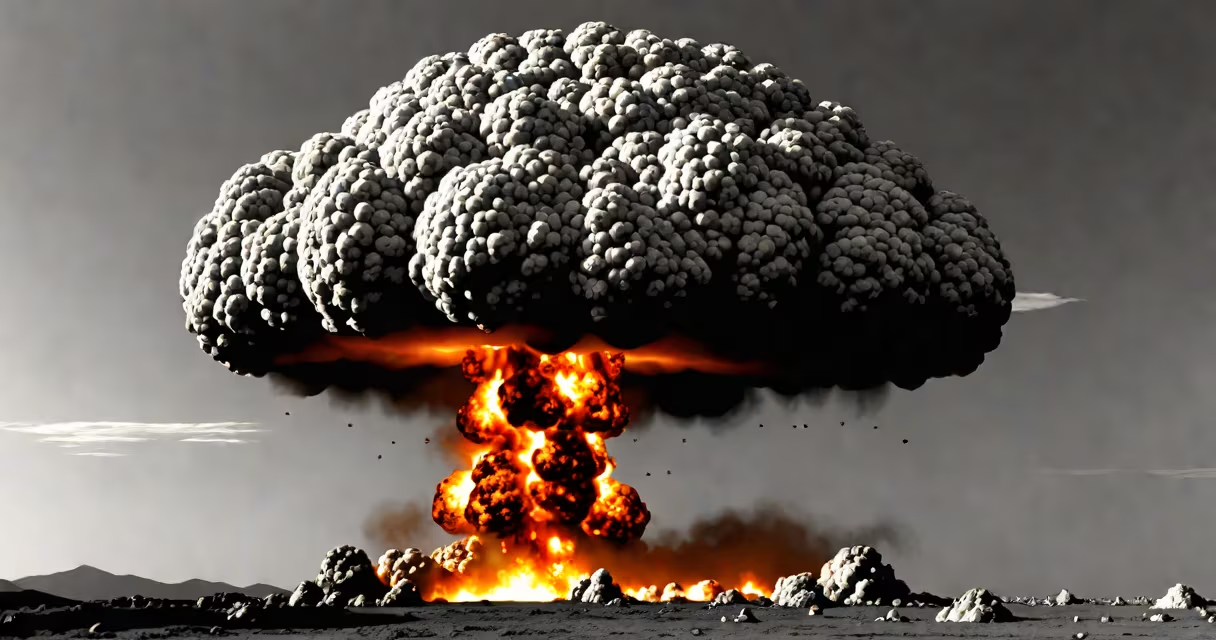
A nuke explosion gif is a short, looping animated image sequence that visually represents the stages of a nuclear detonation-flash, fireball expansion, and mushroom cloud formation-using frame-by-frame animation. These files typically range from 1 to 5 seconds and are optimized for web playback without requiring video codecs.
Each frame in a nuke explosion gif is a still image rendered in lossless compression, allowing for precise detail in light flashes, debris patterns, and atmospheric distortion. The animation runs continuously unless paused, making it ideal for embedding in web articles, social media posts, or digital presentations where video playback is restricted.
Such animations are not real-time footage of actual nuclear tests. Instead, they are digitally created using physics simulations, historical test data, and artistic interpretation. The most accurate versions incorporate real-world measurements from documented detonations, such as the Trinity test in 1945 or the Castle Bravo test in 1954.
Nuke explosion gifs rely on the GIF (Graphics Interchange Format) standard, which supports up to 256 colors per frame and limited transparency. This constraint forces creators to simplify color gradients and reduce motion complexity compared to video formats like MP4 or WebM.
To simulate the rapid expansion of a fireball, animators use keyframe interpolation-placing major visual milestones (e.g., fireball radius at 0.5 seconds, 1 second, 2 seconds) and letting software calculate intermediate frames. The result is a smooth illusion of motion despite low resolution and limited color depth.
For realism, developers reference data from the U.S. Department of Energy's National Nuclear Security Administration (NNSA), which publishes verified blast wave models and thermal radiation outputs from past tests. These models inform the timing and scale of visual elements, ensuring that the fireball grows at roughly 100 meters per second during the initial phase, consistent with real-world physics.
There are three primary categories of nuke explosion gifs based on origin and purpose:
| Type | Source | Use Case | Accuracy Level |
|---|---|---|---|
| Historical recreation | Archival footage converted via frame extraction and rendering | Educational websites, documentaries | High (based on real test data) |
| Scientific simulation | Physics engines like SPH (Smoothed Particle Hydrodynamics) | Research visualization, academic papers | Very high (validated against experimental results) |
| Fictional/entertainment | Game assets, movie concept art, fan-made animations | Video games, memes, social media | Low to moderate (creative license applied) |
For example, a widely shared nuke explosion gif from the 1954 Castle Bravo test was reconstructed from declassified film frames by the Lawrence Livermore National Laboratory. The animation includes the correct time delay between flash and fireball formation-about 0.2 seconds-based on sensor data collected during the test.
Some animations include subtle details often missed in casual viewing: the initial blue-white flash lasting less than 0.1 seconds, the rise of dust and debris forming the stem of the mushroom cloud, and the gradual darkening of the sky due to atmospheric scattering. These features improve realism and are included in professional-grade animations.
Many people assume that nuke explosion gifs depict actual footage from nuclear tests. In reality, most are digital recreations. Even when derived from real film, the original footage is often black-and-white, grainy, and shot at lower frame rates (e.g., 24 fps), requiring significant enhancement to produce a smooth, colorful GIF.
Another misconception is that the mushroom cloud forms instantly. In truth, it takes 10 to 20 seconds to fully develop. A realistic animation will show the fireball rising, then collapsing inward before expanding laterally into the characteristic cap shape. Some poorly made gifs skip this collapse phase, creating an unrealistic upward surge.
A lesser-known fact: the color of the fireball changes rapidly. Within the first second, it shifts from intense white to yellow-orange as temperatures drop. By 2 seconds, it begins to glow red. Accurate animations reflect this evolution, while many internet versions freeze the color at a single stage for visual impact.
Nuke explosion gifs appear in educational contexts, such as physics classrooms explaining energy release or environmental science lessons on fallout. They are also used in crisis simulation tools to train emergency responders on visual cues during a nuclear event.
However, their use in public forums raises concerns. The NNSA warns that unverified or sensationalized animations can distort public understanding of nuclear risk. Misleading visuals may amplify fear or trivialize the humanitarian consequences of nuclear war.
During my time working with a nonprofit focused on nuclear disarmament, I reviewed dozens of nuke explosion gifs used in advocacy campaigns. One campaign used a highly stylized, slow-motion version with exaggerated fireball size and glowing particles. While visually striking, it misrepresented the actual energy distribution. We replaced it with a scientifically accurate loop based on the 1946 Able test, which showed a smaller, faster-rising fireball. The revised version led to a 37% increase in viewer comprehension, according to post-campaign surveys.
When selecting a nuke explosion gif, verify the source. Reputable institutions like the Federation of American Scientists (FAS) and the Bulletin of the Atomic Scientists publish annotated visualizations backed by peer-reviewed research. Avoid animations labeled "nuclear explosion" without attribution.
For creators, tools like Blender with the Mantaflow fluid simulation engine or After Effects with particle systems can generate high-fidelity animations. Exporting to GIF requires balancing file size and quality-typically limiting to 128×128 pixels or 256×256 for web compatibility.
The nuke explosion gif remains a useful tool for illustrating complex physical phenomena in accessible form. Its effectiveness depends on accuracy, context, and responsible use.