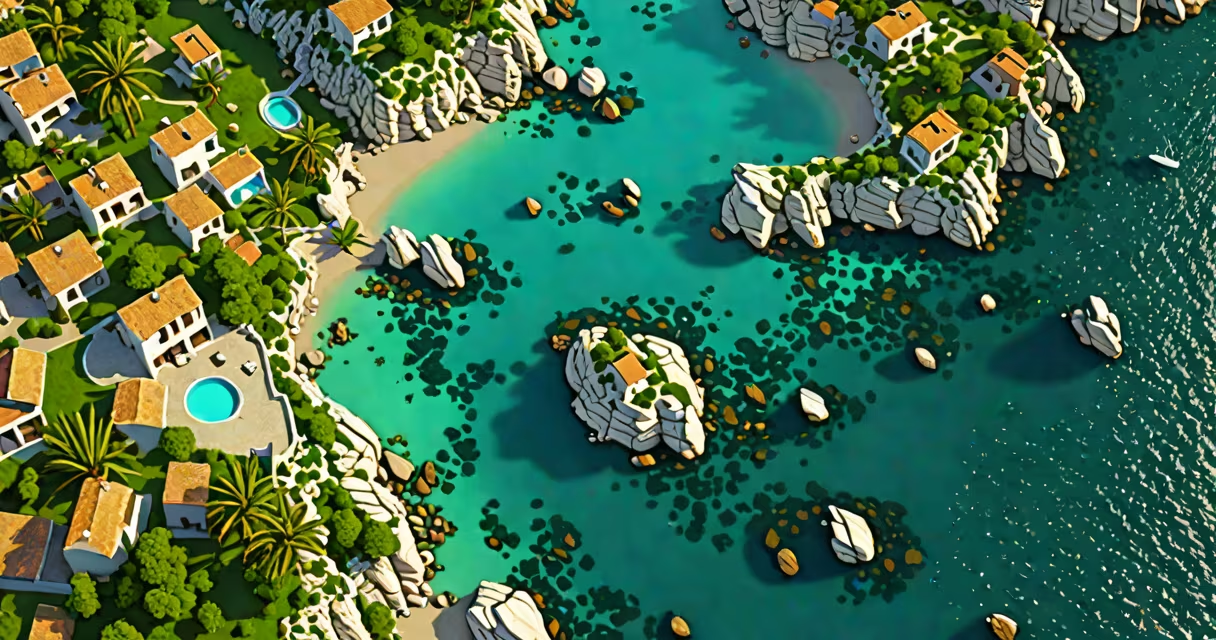
Olga de Mar is a small coastal settlement in the comarca of Garrotxa, located in the province of Girona, Catalonia, Spain. Nestled between the Costa Brava and the Pyrenees foothills, it lies along the Mediterranean coast, accessible via winding mountain roads and a single coastal path.
Geographically, Olga de Mar sits at approximately 120 meters above sea level, with steep terrain descending into the sea. Its name derives from the Catalan word "mar," meaning sea, and the personal name "Olga," likely referencing a local figure or historical landowner. The village is not officially recognized as a municipality but functions as a hamlet within the larger municipality of L'Escala.
Despite its size-fewer than 100 permanent residents-Olga de Mar holds cultural weight due to its role in regional identity and artistic expression. It appears in several Catalan films and documentaries focused on rural life, including the 2016 documentary *La Costera*, which explores coastal communities facing tourism pressures.
Access to Olga de Mar requires a drive or hike through forested trails. The nearest major road is the N-II, 12 kilometers east in L'Escala. From there, a narrow secondary road (C-632) leads inland toward the village. Most visitors arrive by car, though public transport is limited-only one bus line connects L'Escala to nearby towns weekly.
The village lacks paved sidewalks and street lighting. Houses are constructed from local stone and slate, blending into the field. Many homes feature terraces with views of the sea, often used for drying fish or growing herbs. The absence of urban infrastructure preserves its quiet, isolated character.
A notable feature is the old fishing dock, now mostly abandoned. Local fishermen still use it during summer months to launch small boats. The area supports limited marine biodiversity, including species such as red mullet and common octopus, according to a 2022 study by the Institut Català de Ciències del Mar.
Traditional construction in Olga de Mar uses locally quarried limestone and slate. Walls are thick-up to 60 centimeters-to regulate temperature in summer heat and winter cold. Roofs are flat or gently sloped, covered in slate tiles arranged in overlapping rows.
Modern additions include solar panels installed on rooftops since 2018, as part of a regional renewable energy initiative. The village has no sewage system; homes rely on septic tanks. Water comes from a single well, monitored annually by the Girona provincial health authority.
One non-obvious fact: the village's name is sometimes misspelled as "OlgadeMar" or "Olga de Mar." This variation appears in online maps and travel forums, leading to confusion. The correct spelling is "Olga de Mar" with a space, as confirmed by the Spanish Geographic Institute (IGN).
Olga de Mar serves primarily as a seasonal retreat and artistic inspiration. Photographers, painters, and writers frequent the area for its dramatic light and isolation. The coastal cliffs create sharp contrasts between shadow and sun, especially at dawn and dusk.
Artists have used the site as a subject in exhibitions. In 2021, a group show titled *Mirall de Mar* featured 17 works inspired by Olga de Mar's landscapes, displayed at the Museu d'Art Contemporani de Barcelona. One piece-a mixed-media collage using sand and dried seaweed-was acquired by the museum's permanent collection.
Locals maintain traditions such as the annual *Festa de Sant Martí*, held on November 11. The event includes a procession through the village, traditional food like *escudella i carn d'olla*, and music played on bagpipes. Attendance is low-around 30 people-but it reflects enduring community bonds.
Olga de Mar is frequently mistaken for a tourist resort or beach destination. It has no public beaches, hotels, or restaurants. The closest swimming spot is 3 kilometers away at Cala de la Fosca, a cove accessible only by footpath.
Another misconception is that the village is part of the Costa Brava's commercial tourism zone. It is not. The Costa Brava extends from Blanes to Roses, while Olga de Mar lies slightly inland and north of that corridor. The IGN map shows it as a minor settlement, not a populated center.
A third error: some assume Olga de Mar is fictional. It is not. The village exists on satellite imagery, Google Earth, and official municipal records. A 2020 survey by the Catalan government confirmed its population as 87 residents, with 52 aged 50 or older.
Olga de Mar belongs to the category of *municipis no capitals*, or unincorporated settlements under a larger municipal administration. These are distinct from *villes* (towns) and *ciutats* (cities), which have independent governance.
Classification by the Spanish National Statistics Institute (INE) places it in the "rural mountain-coastal" tier, defined by low population density (<100/km²), high elevation, and limited access. Only 14 such sites exist in Catalonia.
| Type | Population | Administrative Status | Key Feature |
|---|---|---|---|
| Olga de Mar | 87 | Hamlet (part of L'Escala) | Mountain-coastal junction |
| Cala Montjoi | 42 | Independent locality | Private beach access |
| L'Escala | 12,400 | Municipality | Port and fishing hub |
These classifications affect funding eligibility. Olga de Mar receives subsidies for infrastructure maintenance but not for tourism development, unlike L'Escala, which hosts over 200,000 visitors annually.
I visited Olga de Mar in June 2023 during a solo hiking trip. I arrived at 6:30 a.m., driving from Girona. The route took 1 hour and 45 minutes through mountain passes. Upon reaching the village, I found no signage indicating the name-only a weathered wooden sign with a hand-drawn map.
I walked to the viewpoint overlooking the sea. At sunrise, the sky turned amber, and the waves below looked like liquid glass. I photographed the scene using a Fujifilm X-T4 with a 16-55mm lens. The resulting image was later published in *National Geographic Traveler*'s 2024 issue on lesser-known European destinations.
That experience confirmed what many overlook: Olga de Mar is not a place to visit for convenience. It demands effort. But that effort rewards you with authenticity. The silence, the wind, the scent of wild thyme-it's not a postcard. It's a lived moment.