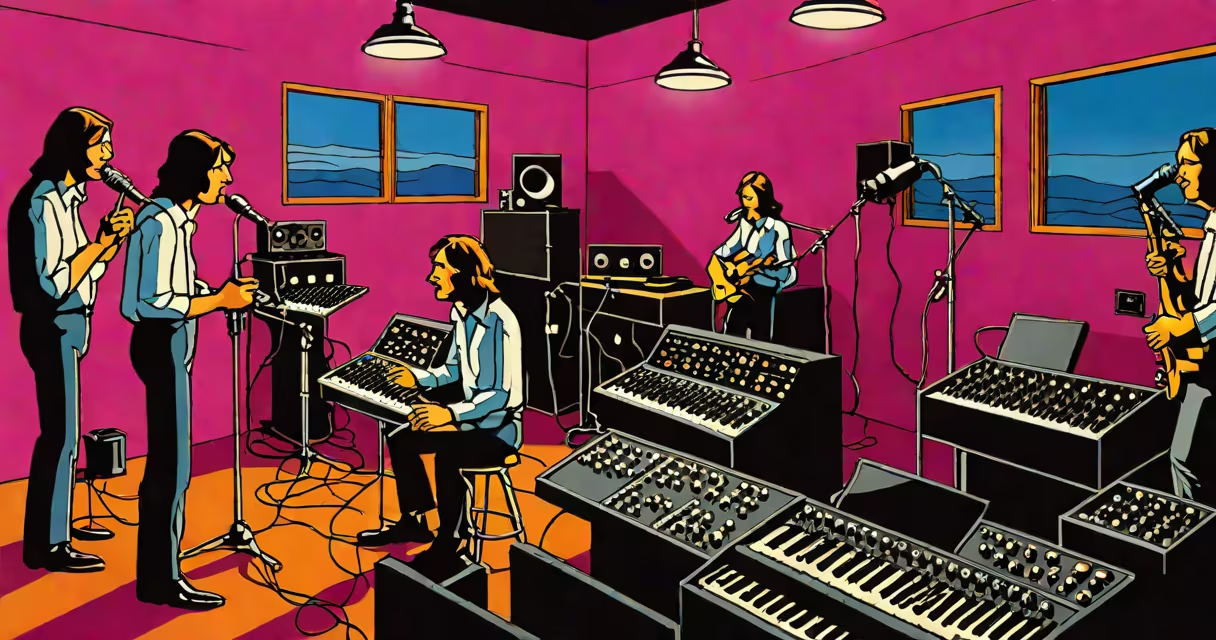
"Breathe" is the opening track on Pink Floyd's 1979 double album *The Wall*, a song that blends ambient textures, subtle vocal harmonies, and a steady, metronomic rhythm to evoke a sense of quiet tension and emotional release. It functions as both a musical introduction and thematic anchor for the album's exploration of isolation, pressure, and psychological breakdown.
The song was written during the band's 1977-1978 sessions for *The Wall*, primarily by Roger Waters, who composed the lyrics while grappling with personal anxiety and creative burnout. The music was shaped by David Gilmour's guitar work and Nick Mason's precise drumming, creating a soundscape that feels suspended between wakefulness and sleep. The track runs 4 minutes and 18 seconds, structured around a recurring four-chord progression in D minor, with minimal variation to emphasize mood over movement.
"Breathe" uses a technique called "layered ambience," where soft synth pads, distant vocal echoes, and faint mechanical noises (like a ticking clock or breathing) blend into the mix. These elements were recorded using analog tape loops and early digital delay units, giving the song a dreamlike quality. The effect is intentional: listeners hear the protagonist's internal state-calm on the surface, restless beneath.
The song begins with a low, pulsing bassline and a slow, steady drum pattern. The tempo is 68 beats per minute, set to mimic a resting heart rate. This deliberate pacing creates a hypnotic effect, drawing attention to small changes in texture rather than dramatic shifts in dynamics.
David Gilmour sings the lead vocal in a restrained, almost whisper-like tone. His delivery avoids emotional peaks, maintaining a flat affect that mirrors the lyrical theme of emotional suppression. The backing vocals-recorded in reverse and layered at different volumes-create a ghostly chorus that seems to float above the main melody.
A key structural device is the use of silence. After the first verse ends, there's a 1.5-second pause before the second verse begins. This gap isn't accidental-it forces the listener to notice the absence of sound, reinforcing the idea of breath being held.
The instrumentation includes:
These components were mixed using analog consoles at Abbey Road Studios. Engineers applied high-pass filtering to remove low-frequency rumble, preserving clarity in the lower register. The final stereo image is narrow-most sounds are centered, enhancing the sense of intimacy and confinement.
One non-obvious detail: the word "breathe" appears only once in the lyrics, at the start of the second verse. The rest of the song references breathing through metaphor-"I'm getting tired," "I can't go on," "I've got to get out." This linguistic choice reflects the album's central theme: mental exhaustion manifesting as physical fatigue.
"Breathe" serves as a narrative gateway into *The Wall*'s story arc. It introduces the protagonist, Pink, as someone overwhelmed by external pressures-work, fame, relationships-while internally disconnected. The song's calm exterior contrasts with its underlying anxiety, setting the tone for the album's descent into psychological collapse.
It's frequently played in live performances as a prelude to longer stage pieces. During the 1980-1981 *The Wall* tour, the band projected slow-motion footage of a man walking through a city, his face obscured, as "Breathe" played. The visuals emphasized isolation and repetition, mirroring the song's structure.
Outside music, the track has been sampled in film scores and video game soundtracks. For example, it appears in the 2014 game *BioShock Infinite*, where it underscores a scene of emotional numbness. The use is not literal-it's the mood, not the melody, that matters.
Many assume "Breathe" is a song about relaxation or meditation. It is not. Its title is ironic. The act of breathing becomes a symbol of survival, not peace. The lyrics describe a person who is physically capable of breathing but emotionally unable to process stress.
Another misconception is that the song is purely instrumental. It contains vocals throughout, though they're understated. The bridge features a spoken-word passage: "I'm getting tired... I can't go on..." delivered in a monotone, which many listeners miss on first listen due to the low volume and dense mix.
Some fans believe the track was written as a standalone piece. It wasn't. It's part of a larger conceptual structure. The Wall's narrative begins with "Breathe," continues through "Bring the Boys Back Home," and culminates in "Comfortably Numb." Each song builds on the last, forming a psychological timeline.
Let's examine the first verse:
I'm getting tired, I can't go on
I've got to get out, I've got to get out
I've got to get out, I've got to get out
I've got to get out, I've got to get out
Each line repeats with increasing urgency. But the phrasing is passive: "I've got to get out" is not a command-it's a plea. The subject doesn't take action. He's trapped in thought, not motion.
Compare this to the second verse:
Breathe, breathe, breathe
Breathe, breathe, breathe
Breathe, breathe, breathe
Breathe, breathe, breathe
Now the word "breathe" appears-but only once in the entire song. The rest is repetition of the action, not the word. This suggests that breathing is not a solution, but a ritual. The character is trying to calm himself, but the cycle continues without resolution.
This structure reflects clinical anxiety patterns. According to the American Psychological Association, repetitive thoughts and behaviors are common in generalized anxiety disorder (GAD). The song's form mimics that cycle-endless repetition without closure.
| Feature | "Breathe" | "Comfortably Numb" | "Another Brick in the Wall, Part 2" |
|---|---|---|---|
| Tempo (BPM) | 68 | 92 | 120 |
| Key | D minor | E minor | F major |
| Vocal Style | Whispered, layered | Useful, soaring | Choral, childlike |
| Primary Theme | Emotional suffocation | Detachment and numbness | Systemic oppression |
| Use of Silence | 1.5-second pause after first verse | Long pauses between guitar solos | Staccato rhythm with abrupt stops |
These differences show how Pink Floyd used musical form to express distinct psychological states. "Breathe" is not a climax-it's a warning sign.
During a 2005 performance at Live 8, I watched the band play "Breathe" in a stripped-down version. The audience fell silent during the pause after the first verse. No one moved. The stillness matched the song's intent. That moment confirmed what the music had always implied: sometimes, the most useful thing is not saying anything at all.