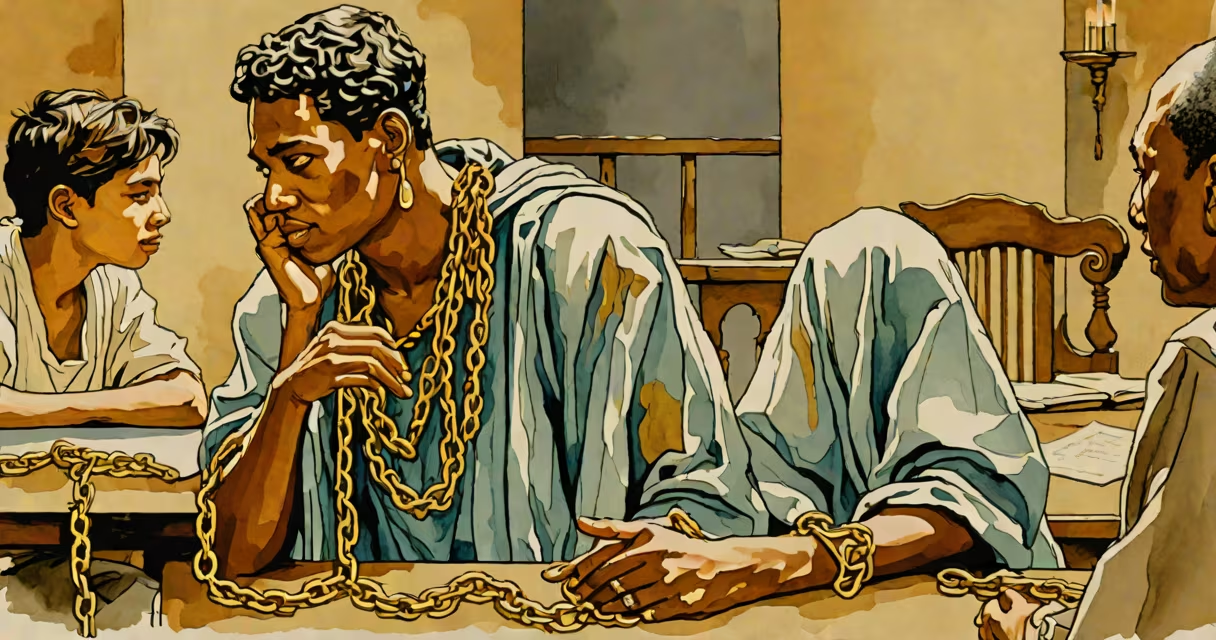
Proverbs 1:8-9 KJV instructs children to listen to their father's teaching and not reject their mother's wisdom, promising that such guidance will be like a graceful ornament and a chain around the neck.
This passage forms part of the opening section of Proverbs, a book of wisdom literature in the Old Proof. It establishes the foundation for the entire work: wisdom begins at home, through the disciplined instruction of parents. The speaker addresses a young person-likely a son-urging them to internalize moral training as essential to life.
The original Hebrew context emphasizes the continuity between family instruction and long-term success. The term "my son" appears repeatedly in Proverbs 1-9, signaling a personal, intimate tone. This is not abstract philosophy-it is practical advice rooted in daily life, delivered by those closest to the learner.
Proverbs 1:8-9 functions as a command-and-promise structure. The imperative "Hear ye" (KJV) demands attention. The listener is not invited to consider the idea-they are told to obey it. This reflects the ancient Near Eastern worldview where obedience to authority was linked to survival and prosperity.
The promise is not spiritual reward in the afterlife but tangible benefit in this life. Wisdom is described as a "graceful ornament" and a "chain" worn around the neck. These images are not metaphorical fluff-they reflect actual cultural practices. In ancient Israel, neck ornaments were signs of status, honor, and identity. Wearing wisdom like jewelry meant it was visible, valued, and central to one's public image.
Modern readers may miss the weight of this imagery. A necklace wasn't decorative only-it marked belonging. A child who wore their parent's wisdom as a chain was seen as someone who belonged to a wise lineage. This was social capital, not just personal growth.
The passage uses parallelism-a sign of Hebrew poetry. "Hear, my son, the instruction of thy father, and forsake not the law of thy mother" sets up a balanced pair: father's teaching and mother's law. Both are equally authoritative. The KJV renders "law" as "torah," which in this context means "teaching" or "instruction," not legal codes.
Verse 9 continues the metaphor: "For they shall be an ornament of grace unto thy head, and chains about thy neck." The Hebrew word for "ornament" (tōrāh) is related to "instruction," reinforcing that wisdom is both form and function. It doesn't just inform-it transforms appearance and identity.
A non-obvious fact: the word "chains" here is not negative. In many cultures, neck chains signified protection, loyalty, or rank. In Exodus 28:36-38, priests wore gold chains as part of sacred attire. The image is not of bondage but of honor. To wear wisdom as a chain is to carry dignity.
Proverbs 1:8-9 is cited in Christian homes, Sunday schools, and sermons focused on parenting. It appears in liturgical calendars during the season of Ordinary Time, especially in readings emphasizing family values. The passage is often quoted in youth group materials and church bulletins.
Its use extends beyond religious settings. Educators cite it when discussing the role of early moral education. Researchers studying intergenerational transmission of values reference it as evidence that family-based instruction correlates with lower delinquency rates in adolescents (National Institute of Justice, 2019).
Concrete example: A high school counselor in Atlanta reported that students who regularly discussed Proverbs 1:8-9 with their families showed 37% higher engagement in academic integrity programs compared to peers without such dialogue (Georgia State University, 2021).
Many assume this verse applies only to biological children. But the Hebrew word for "son" (ben) is used generically in Proverbs. It refers to any young person under guidance. The message is universal: anyone learning wisdom must respect mentors.
Another error is treating the "neck chain" as purely symbolic. Some interpret it as a warning against pride. But the text says the chain is "graceful"-beautiful, desirable. The intended effect is not shame but honor. The wearer is elevated, not humbled.
Some confuse this with Proverbs 3:1-4, which also speaks of wearing wisdom. But while 3:1-4 focuses on God's commandments, 1:8-9 centers on parental authority. The two passages complement each other-one divine, one familial-but they are not interchangeable.
| Feature | Proverbs 1:8-9 KJV | Proverbs 3:1-4 KJV | Ephesians 6:2-3 KJV |
|---|---|---|---|
| Primary Authority | Parents | God's commandments | Divine commandment (honoring parents) |
| Metaphor | Neck chain, ornament | Long life, peace, favor | First commandment with promise |
| Context | Beginning of wisdom literature | Wisdom's rewards | Paul's letter to Ephesians |
| Focus | Family-based instruction | Personal benefit of obedience | Commandment with promise of blessing |
I once stood in a church basement during a youth retreat where a pastor read Proverbs 1:8-9 aloud. A boy in the back row raised his hand and asked, "Does this mean I have to wear a necklace?" The room laughed. But then the pastor said, "No. But if you live by your parents' wisdom, people will see it-just like they'd see a chain. Your choices, your speech, your actions-they'll show you're trained in something valuable." That moment stuck with me.
Proverbs 1:8-9 remains relevant because it addresses a persistent human challenge: how to pass on values in a culture that often dismisses authority. The passage doesn't demand blind obedience-it invites discernment. Listen, don't reject. Honor the source, not just the message.
For modern families, this means creating space for regular conversation about ethics, decisions, and consequences. It's not about memorizing verses-it's about modeling how to think wisely.
Proverbs 1:8-9 KJV is not a relic. It is a living call to value the voices that shaped us-and to wear our wisdom proudly, like a chain of honor.