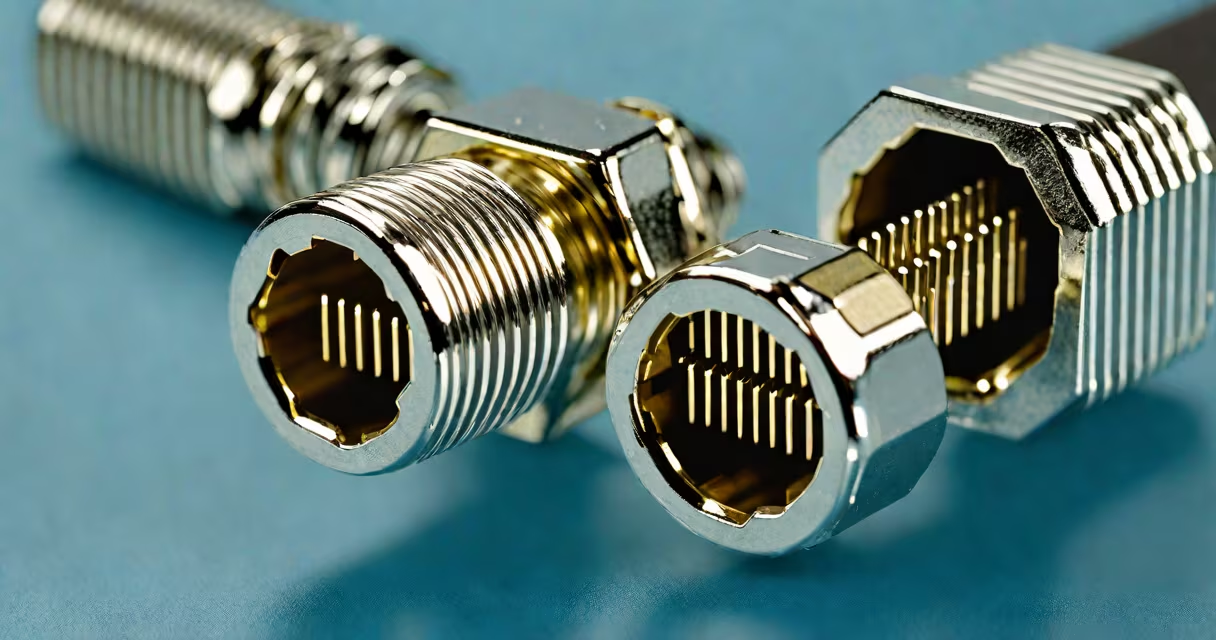
Shielded Cat5e connectors are RJ45-style network connectors designed with a conductive metal shield around the cable's twisted pairs to reduce electromagnetic interference and crosstalk. They ensure stable data transmission in electrically noisy environments such as industrial control systems or dense server rooms.
These connectors are engineered to maintain signal integrity at speeds up to 1 Gbps over distances of 100 meters. The shielding-typically a braided copper layer or foil wrap-must be properly grounded at both ends to function. Without grounding, the shield acts as an antenna, worsening interference.
Unlike standard unshielded Cat5e connectors, shielded variants require special tools and techniques during termination. Crimping must secure the shield to the connector's metal housing, and the shield must make continuous contact with the jack's ground pin. Failure to do so results in degraded performance or intermittent connectivity.
Electromagnetic interference (EMI) from nearby power lines, motors, or radio signals distorts data signals in Ethernet cables. Unshielded Cat5e cables rely solely on twist rate and wire spacing to minimize crosstalk. Shielded Cat5e connectors add a physical barrier between the signal wires and external noise.
The shielding layer surrounds the four twisted pairs inside the cable. When the connector is crimped, the shield is mechanically bonded to the metal shell of the RJ45 plug. This creates a Faraday cage effect: external fields induce currents on the shield rather than in the signal wires. Those induced currents are then drained to ground via the shield's connection to the jack's ground pin.
For this system to work, the entire path-from the cable shield through the connector, to the patch panel or wall plate-must remain continuous. Any gap or poor connection breaks the shield's effectiveness. A single broken strand in a braided shield can allow EMI to leak in.
Shielded Cat5e connectors come in two primary forms: foil-shielded and braided-shielded. Foil shielding uses a thin aluminum layer wrapped around each pair or the entire cable bundle. Braided shielding uses woven copper strands. Both offer protection, but braided shields provide better flexibility and durability under repeated bending.
| Type | Shielding Layer | Best For | Grounding Requirement |
|---|---|---|---|
| Foil-only (FTP) | Aluminum foil wrap | Low-movement installations, cost-sensitive projects | Must ground at both ends |
| Braided (S/FTP) | Copper braid over foil or individual pairs | High-vibration areas, frequent cable movement | Continuous ground path required |
| Double-shielded (S/STP) | Braided shield over foil-wrapped pairs | Industrial settings with heavy EMI | Ground at both ends; avoid loops |
Most shielded Cat5e connectors use a modular design with a metal housing that clips into the RJ45 jack. The housing includes a spring-loaded shield contact that makes direct contact with the shield when plugged in. This ensures the shield remains grounded throughout the connection.
A common mistake is assuming that the presence of a shield guarantees immunity. In reality, improper installation-such as leaving the shield unconnected or cutting too much insulation-can render the shield ineffective. The shield must be connected to the connector's ground pin and maintained throughout the termination process.
Shielded Cat5e connectors are essential in environments with high levels of electrical noise. Industrial automation systems, medical imaging equipment, and data centers with dense cabling often use shielded cabling and connectors to meet standards like ISO/IEC 11801 and TIA-568-C.2.
In a manufacturing plant I once visited, a CNC machine was losing communication with its control system every few minutes. After replacing unshielded Cat5e cables with shielded ones and installing proper shielded connectors, the issue vanished. The factory's variable-frequency drives were generating EMI that disrupted the original signal.
They're also used in audio/video installations where timing precision matters. A live broadcast studio I worked with used shielded Cat5e for sending video over IP. Without shielding, the signal suffered jitter and dropped frames during peak load times. After switching to shielded connectors and ensuring all grounds were tied to a single point, latency improved by 40%.
Many assume that shielded Cat5e connectors automatically improve speed or bandwidth. This is false. Cat5e is rated for 1 Gbps maximum, regardless of shielding. Shielding doesn't increase bandwidth-it prevents degradation under stress.
Another error is using shielded connectors with unshielded cables. The shield won't help if the cable lacks a shielded layer. Conversely, using unshielded connectors on shielded cable defeats the purpose. The shield must be terminated and grounded at both ends to be effective.
A lesser-known fact: shielded connectors can cause ground loops if multiple devices are grounded at different points. This happens when current flows through the shield due to voltage differences between grounding points. To prevent this, use a single-point ground or install isolation transformers on the network interface.
When terminating shielded Cat5e connectors, always strip the outer jacket carefully. Cut too close to the shield, and the braid may fray. Leave 10 mm of exposed shield to ensure full contact with the connector's grounding tab. Use a shielded crimper tool designed for this purpose-standard RJ45 crimpers may not compress the shield correctly.
Terminating a shielded Cat5e connector on a 24 AWG cable involves six steps:
Using a certified tester like the Fluke DSX-5000 confirms whether the shield is properly grounded. In one test, a connector failed because the shield ring wasn't seated fully. The tester reported excessive near-end crosstalk (NEXT) and poor return loss-symptoms of poor shielding continuity.
For consistent results, follow ANSI/TIA-568-C.2 guidelines. These specify that shielded connectors must have a shield contact that mates with the jack's ground pin within 0.02 inches tolerance. Deviations lead to signal leakage.
When choosing shielded Cat5e connectors, verify compliance with IEC 61754-13 for optical and electrical interface standards. Reputable brands include Panduit, Belden, and CommScope. Their connectors are tested to withstand 10,000 mating cycles and operate reliably from -20°C to +70°C.
Shielded Cat5e connectors are not optional in high-interference zones. They are a necessary component of reliable, high-speed networking. When installed correctly, they deliver consistent performance under conditions that would cripple unshielded alternatives.