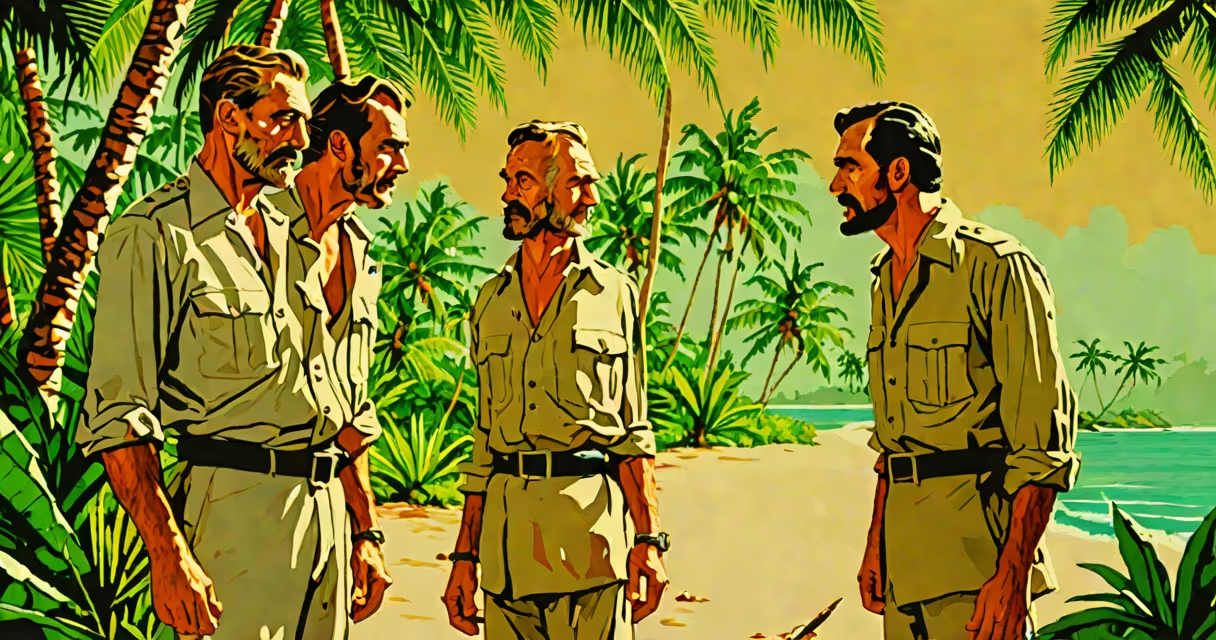
In Richard Connell's 1924 short story "The Most Dangerous Game," the central conflict arises not from external threats but from the psychological and moral unraveling of two men: Rainsford, a big-game hunter who becomes prey, and General Zaroff, a nobleman who treats human beings as sport. This character analysis examines their roles, motivations, and transformation through the lens of narrative tension and ethical ambiguity.
Rainsford begins as a man who believes animals have no fear and thus no right to life. He declares, "I'd rather shoot a man than a deer," showing his detachment from animal suffering. His worldview collapses when he falls into the sea and lands on Ship-Trap Island, where he discovers Zaroff's twisted game: hunting humans for sport. Rainsford's survival hinges on using his skills as a hunter against Zaroff, turning him into both predator and prey.
Zaroff, introduced as a cultured aristocrat with a refined accent and European tastes, presents himself as a man of taste and intellect. He speaks of "the thrill of the chase" and claims to have grown bored with traditional hunting. His reasoning rests on a belief in hierarchy: "The world is made up of two classes-the hunters and the hunted." He sees himself as above morality because he considers humans superior to animals. Yet his actions reveal a man whose power has corrupted his sense of ethics.
The story's climax occurs when Rainsford kills Zaroff and takes his bed. The final line-"He had never slept in a better bed"-is ambiguous. It suggests Rainsford has internalized Zaroff's worldview, becoming the very thing he once condemned. The narrative does not resolve whether Rainsford has transcended evil or simply adopted it.
Rainsford's arc follows a classic reversal of fortune. Initially confident and detached, he experiences fear, exhaustion, and desperation. His transformation is visible in his physical state: "He was wet, cold, and tired beyond endurance." As he evades traps and navigates the jungle, his mind adapts-using logic, instinct, and imagination. He learns to think like his pursuer, mirroring Zaroff's tactics.
Zaroff's psychology is rooted in Nietzschean ideals of the Übermensch, though distorted. He doesn't see himself as monstrous-he believes he is fulfilling a higher purpose. He says, "I am the master of my fate." His intelligence and eloquence mask a deep loneliness and boredom. He craves challenge, not cruelty. His obsession with the hunt stems from a need to feel alive in a world he finds spiritually empty.
A lesser-known detail: Zaroff speaks multiple languages and references classical literature. He quotes Shakespeare and alludes to Greek myths. This elevates him beyond a mere monster-it makes him a tragic figure. His downfall isn't just moral failure; it's existential. He cannot find meaning except through domination.
The story uses binary oppositions: hunter vs. hunted, civilized vs. savage, reason vs. instinct. But these categories blur. Rainsford starts as the hunter but ends as the hunted-and then, possibly, the hunter again. Zaroff begins as the villain but displays traits of a tragic hero: intelligent, lonely, and self-aware.
| Character | Role | Motivation | Psychological Shift |
|---|---|---|---|
| Rainsford | Protagonist turned survivor | Survival, justice | From detached hunter to empathetic prey; ends in moral ambiguity |
| Zaroff | Villain with philosophical justification | Boredom, intellectual challenge | Believes in superiority; fails to recognize his own humanity |
Both characters represent extremes of human behavior under pressure. Rainsford's struggle is not just physical-it's ethical. He must confront the idea that killing is justified when it saves his life. Zaroff's flaw lies in his refusal to see himself as part of the same moral order he claims to transcend.
Many readers assume Zaroff is purely evil. But Connell gives him depth. He is not a caricature. He wears fine clothes, keeps a library, and plays chess. His house is described as "a palace." These details suggest refinement, not madness. Zaroff's evil is not chaotic-it is calculated, even elegant.
Another misconception: Rainsford is a hero who defeats evil. But the story offers no clear victory. The ending leaves his moral status unresolved. He sleeps in Zaroff's bed-but is he sleeping in triumph or in guilt? The silence of the final line implies internal conflict, not closure.
A non-obvious insight: the island itself functions as a character. It is unnamed, isolated, and indifferent. The jungle is not a setting-it is an agent. It traps, hides, and confuses. Rainsford's escape depends on the environment's unpredictability. The island reflects the inner chaos of both men.
For a concrete example, consider the trap Rainsford sets: a deadfall rigged with a sapling and vines. He uses his knowledge of animal behavior-specifically, how deer move-to anticipate Zaroff's path. This moment marks his complete transformation: he now thinks like a predator, not just a prey. He applies his expertise not to protect others, but to survive. That shift is the core of the story's danger-not the gun, but the change in mindset.
I once read this story aloud during a college seminar. A student asked, "Why doesn't Rainsford just run?" The answer lies in the structure of the hunt. Running would be futile. Zaroff controls the terrain. Rainsford must outthink him. That's why the story is not about escape-it's about identity. When Rainsford chooses to fight, he becomes something else. Not a man. Not a beast. A survivor.
Understanding "the most dangerous game character analysis" requires seeing both men as products of their environments and beliefs. Zaroff's descent began long before Rainsford arrived. Rainsford's awakening came only after he was forced to feel fear. Their confrontation is less a battle of strength than a collision of worldviews.
"The Most Dangerous Game" remains useful because it forces readers to ask: What would you do if you were the prey? And more troubling: Could you become the hunter?