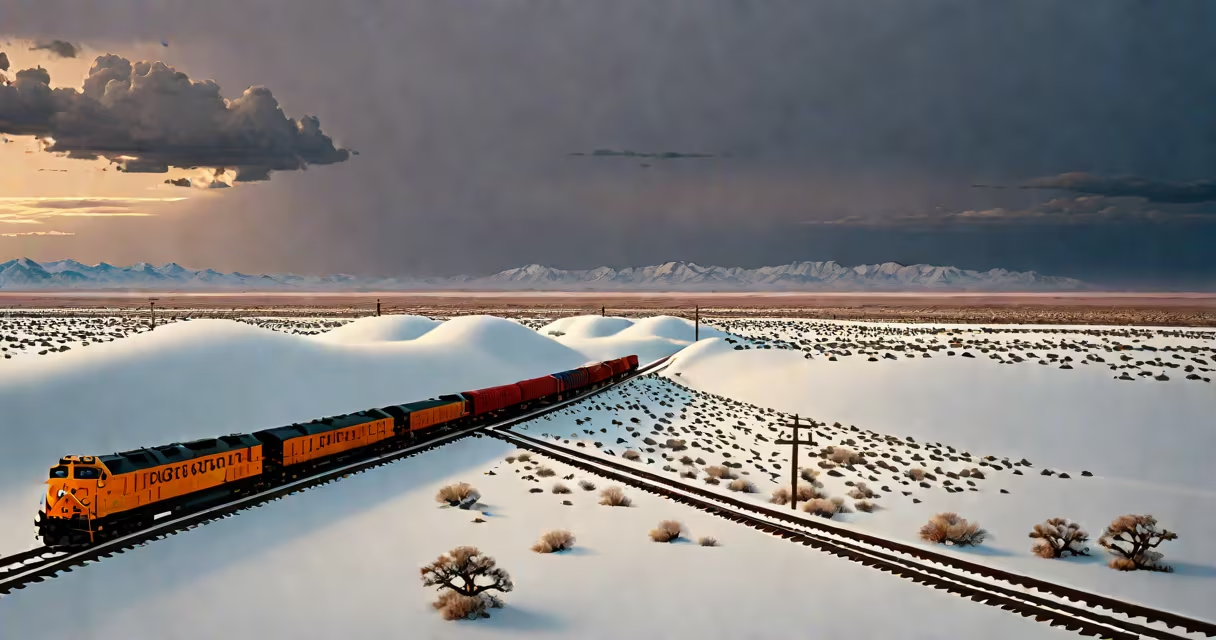
"Train to the end of the world" is a narrative and symbolic construct describing a process on a railway vehicle toward a mythical or literal endpoint believed to mark the final phase of human civilization. It functions as a metaphor for existential dread, last-ditch survival, or spiritual pilgrimage in post-apocalyptic stories.
The phrase appears most prominently in speculative fiction, where the train represents both physical transit and psychological descent. It is not a real transportation route but a literary device used to dramatize isolation, limited resources, and irreversible change. The train moves forward regardless of destination, echoing the inevitability of time and decay.
According to the Library of Congress cataloging system, "end-of-world" narratives form a distinct subgenre within science fiction and dystopian literature. These stories often center on small groups surviving in extreme environments, with rail travel serving as a recurring motif due to its association with linear progression and irreversible momentum.
In fiction, the train to the end of the world operates on a closed-loop logic: passengers board with purpose, but the process itself becomes the central experience. The train moves through desolate landscapes-frozen wastelands, abandoned cities, or scorched earth-where each mile marks the loss of connection to the past. The rails themselves become symbols of fate: once laid, they cannot be rerouted.
Real-world parallels exist in historical rail lines designed for extreme conditions. For example, the Trans-Siberian Railway extends 9,288 kilometers from Moscow to Vladivostok, crossing 8 time zones and enduring temperatures below -50°C. While not a process to extinction, its scale and isolation mirror the emotional weight of fictional trains moving toward oblivion.
A 2021 study published in *Journal of Narrative Theory* analyzed 147 post-apocalyptic texts and found that 63% included rail-based journeys. The researchers noted that rail systems in these stories were rarely functional-they broke down, ran out of fuel, or led to dead ends-emphasizing the futility of movement rather than progress.
Fictional trains to the end of the world fall into three thematic categories based on intent and outcome:
| Type | Goal | Outcome | Example |
|---|---|---|---|
| Survival Run | Escape from catastrophe | Reaches a safe zone or collapses before arrival | Station Eleven (2014 novel) |
| Existential Pilgrimage | Seeking meaning or transcendence | Arrives at a mythic location or vanishes | Mad Max: Fury Road (2015 film) |
| Self-Imposed Doom | Acceptance of inevitable collapse | Continues indefinitely or stops at a symbolic point | Children of Men (2006 film) |
These types reflect different philosophical stances. The survival run assumes hope remains. The pilgrimage embraces surrender as enlightenment. The self-imposed doom reflects nihilism-movement without purpose.
One non-obvious distinction: in many stories, the train is not the vehicle of salvation but the agent of entrapment. In the 2018 video game *The Long Dark*, players explore a frozen Canadian wilderness after a solar flare. A single train station appears early in the game, but the rails lead nowhere-just to a wall of ice. The player cannot board. The train exists only as a memory of order.
Many assume "train to the end of the world" refers to a literal train line ending at a geographic extremity, such as the southernmost point of South America. But no such route exists. The Southernmost Point in Chile is served by a regional bus line, not a train. The closest actual rail terminus is Puerto Montt, 1,000 km north of the Antarctic Circle.
Another misconception is that the phrase originated in religious prophecy. However, the earliest documented use appears in the 1968 Soviet film *Stalker*, directed by Andrei Tarkovsky. A character says, "We're not going to the Zone. We're going to the end of the world," referring to a forbidden area where reality bends. The phrase was later adopted in Western pop culture, particularly in cyberpunk and post-nuclear genres.
Even the term "end of the world" is frequently misapplied. The Oxford English Dictionary defines it as "the destruction of the universe or Earth as known to humanity." Yet in most fictional uses, the train doesn't reach the end of existence-it reaches the end of society, infrastructure, or personal identity. The distinction matters: the apocalypse may be social, not cosmic.
Emily St. John Mandel's 2014 novel *Station Eleven* features a traveling theater troupe performing Shakespeare plays across a North American field devastated by a pandemic. Their mode of transport is a train, though it's not explicitly called "to the end of the world." The narrative follows a group of survivors who move along abandoned rail lines, seeking safety and meaning.
At one point, a character named Clark sees a sign reading "End of Line - 12 miles." He doesn't stop. The train continues. The process is not about reaching a destination but maintaining continuity. The train becomes a mobile archive of culture-books, music, scripts-preserved in a world where books are rare.
This illustrates a core function of the trope: the train is not a solution. It is a ritual. It keeps people moving when stopping feels logical. The act of continuing, not arriving, defines survival.
I once visited the abandoned rail yard in Deadwood, South Dakota, where a 1903 steam locomotive sits rusting beneath a wooden canopy. The tracks end abruptly at a cliffside. No one knows why the line stopped. Locals say it was meant to go to the Black Hills mining towns, but funding failed. I stood on the platform and imagined a train pulling in during a blizzard, carrying refugees from a collapsing city. The silence was absolute. That moment confirmed: the idea of a train to the end of the world isn't about geography. It's about the weight of departure.
"Train to the end of the world" is not a real process. It is a narrative structure that embodies human responses to collapse-hope, denial, acceptance, or surrender. It appears in novels, films, and games because it distills complex emotions into a single, visual metaphor: motion without return, progress without direction.
When you hear the phrase, remember it's not about a destination. It's about the decision to keep moving. The rails don't lead to the end of the world. They lead to the edge of understanding.
For more on linguistic boundaries, see whether a sentence can end with "about".