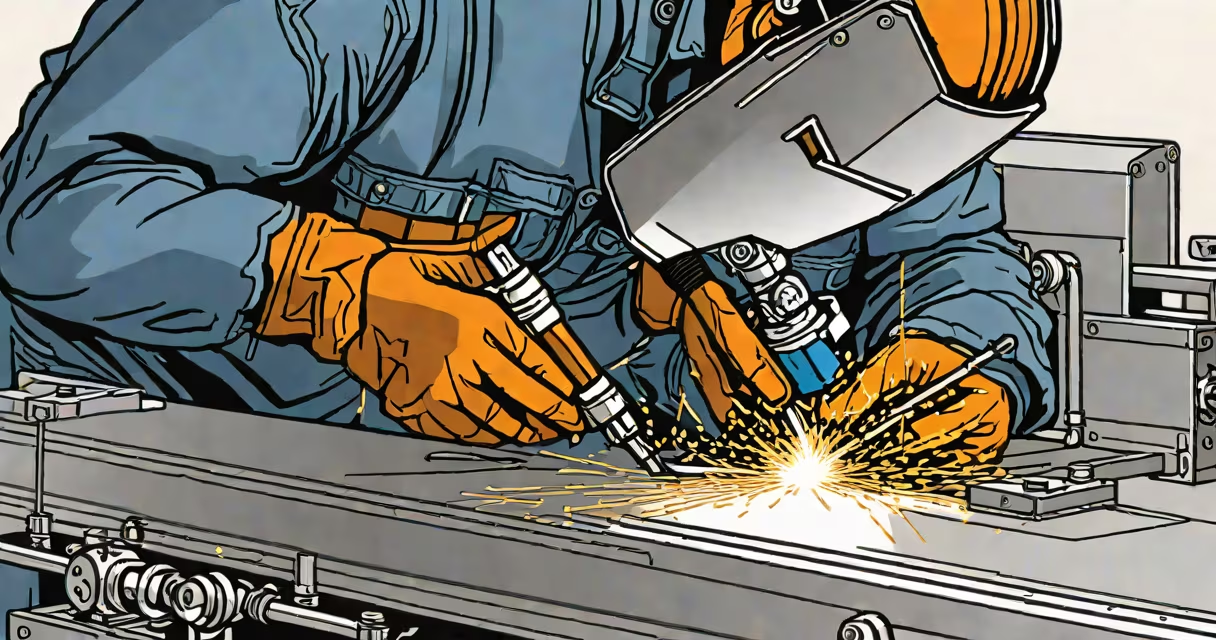
To weld stainless steel successfully, you need a TIG welder, compatible filler metal like ER308L, high-purity shielding gas (argon), and meticulous surface preparation. The process demands precision to preserve the alloy's corrosion resistance and structural integrity.
Stainless steel resists rust due to chromium content (minimum 10.5%), but improper welding introduces heat-affected zones prone to cracking and corrosion. A single mistake-like using contaminated tools or incorrect gas-can compromise the entire joint. This isn't just about joining metal; it's about maintaining material performance.
For example, a 304 stainless steel pipe welded with a 316 filler rod may appear fine visually, but the mismatched chemistry increases risk of intergranular corrosion under stress. Proper selection prevents failure in applications like food processing equipment or medical devices.
The foundation of successful stainless steel welding lies in three elements: equipment, materials, and preparation. Each must align with the alloy type and service environment.
TIG (GTAW) welding is standard for stainless steel. It offers precise control over heat input and allows clean, high-quality beads. MIG (GMAW) can work for thicker sections but requires strict gas purity and wire cleanliness. Stick welding (SMAW) is rarely used due to poor control and higher risk of contamination.
Filler metals must match the base alloy. For 304 stainless, use ER308L; for 316, use ER316L. These grades contain low carbon to reduce sensitization-a condition where chromium carbides form at grain boundaries, weakening the material. Using a higher-carbon filler increases the risk of intercrystalline corrosion, especially in environments with chlorides.
| Base Alloy | Recommended Filler Metal | Purpose |
|---|---|---|
| 304 | ER308L | Low carbon; resists sensitization |
| 316 | ER316L | Contains molybdenum for chloride resistance |
| 321 | ER347 | Stabilized with niobium to prevent carbide formation |
Shielding gas must be 100% argon, free of moisture and oxygen. Even trace contaminants cause discoloration (heat tint) and weaken the weld. Argon flow rates should be 15-25 cubic feet per hour, adjusted for ambient conditions and joint geometry.
Surface prep is non-negotiable. Any iron particles from grinding or handling can lead to rust spots-even in finished welds. Use dedicated stainless steel tools and clean rags. Avoid steel brushes unless they're exclusively for stainless steel.
Before welding, clean the joint with acetone or isopropyl alcohol. Remove mill scale with a stainless steel wire brush or abrasive pad. After cleaning, avoid touching the surface with bare hands-oils from skin can cause pitting during service.
I once repaired a stainless steel kitchen hood using a MIG welder. Despite setting correct amperage, the weld developed pits after a week. Inspection revealed iron contamination from a shared grinding wheel. Switching to dedicated tools and cleaning with ethanol resolved the issue. This isn't theoretical-it happens in real shops.
Many welders assume that any TIG setup works for stainless steel. That's false. The tungsten electrode must be pure tungsten (not thoriated or ceriated) for better arc stability and reduced spatter. A 2% thoriated electrode can introduce impurities into the weld pool.
Another error is insufficient back purging. On thin-walled tubing or pipes, the inside of the joint must be shielded with argon to prevent oxidation. Without it, the inner surface turns dark gray or black-indicating oxide formation that weakens the joint. Use a purge kit with flow meter and pressure gauge for consistent results.
Some believe that welding speed doesn't matter. But too slow a travel rate causes excessive heat buildup, leading to warping and increased risk of hot cracking. Too fast, and the weld lacks penetration. Ideal travel speed ranges from 2 to 4 inches per minute, depending on thickness and current.
If you're working on critical components-such as pressure vessels, aerospace parts, or biomedical implants-certification matters. AWS D1.6 covers welding procedures for stainless steel. A qualified welder must pass tests using the same process, filler, and parameters as production.
For hobbyists or small shops, start with 304 stainless and ER308L filler. Practice on scrap pieces using a 1/16-inch diameter tungsten electrode and 100 amp settings. Monitor the bead profile: it should be smooth, slightly convex, and free of undercutting or porosity.
Welding stainless steel isn't just a skill-it's a discipline. Success hinges on material selection, tool hygiene, and environmental control. Get the basics right, and your joints will last decades without degradation.