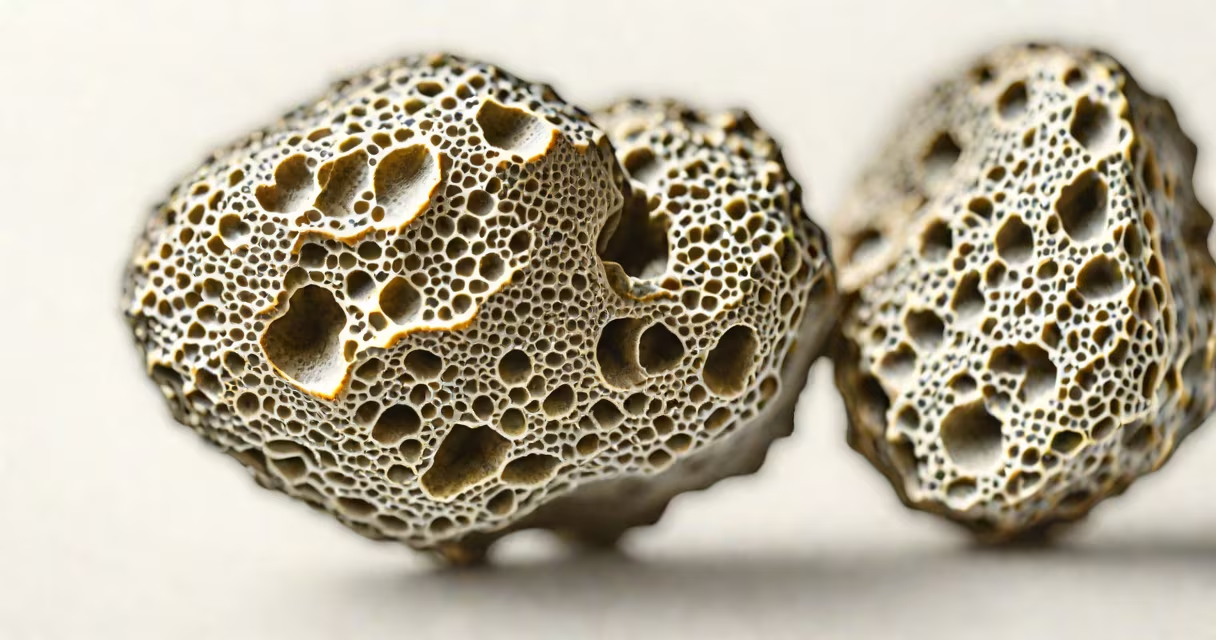
Kidney stones are small, hard mineral deposits that form in the kidneys and can vary widely in size, shape, and color. They may resemble grains of sand, pebbles, or even small fragments of coral. Most are between 2 and 6 millimeters in diameter, though some grow larger than 1 centimeter.
When passed in urine, kidney stones often appear as tiny, irregularly shaped masses. Their surface is typically rough or jagged, with visible cracks or ridges. Colors range from pale yellow to dark brown or black, depending on composition. Calcium oxalate stones-the most common type-are usually yellowish or tan. Struvite stones, linked to urinary tract infections, tend to be darker and more opaque. Uric acid stones are often clear or light amber, while cystine stones have a distinctive translucent, glassy appearance.
Imaging scans such as CT scans show kidney stones as dense, white spots against the soft tissue of the kidney. On ultrasound, they appear as bright echoes with shadowing behind them. During surgical removal, stones are often described as gritty, hard lumps that resist pressure. A 2021 study published in *The Journal of Urology* found that 78% of patients who passed stones reported seeing them in their urine, with most describing them as "pebble-like" or "gritty."
Kidney stones develop when substances in urine-like calcium, oxalate, uric acid, or cystine-become highly concentrated. As water levels drop, these minerals crystallize and bind together into solid masses. Over time, they grow larger and may move from the kidney into the ureter, causing intense pain.
The formation process begins at a microscopic level. Once a seed crystal forms, it attracts more minerals. Growth occurs slowly-over weeks or months-until the stone reaches a size that triggers symptoms. Smaller stones (under 5 mm) often pass unnoticed, while larger ones cause obstruction and severe pain. A 2020 review in *American Family Physician* noted that stones larger than 6 mm have a 30% chance of getting stuck in the ureter, requiring medical intervention.
When a stone passes through the urinary tract, it may be expelled in urine. Patients often describe finding a small, hard object in the toilet or in their underwear. Some report seeing it after straining urine through a filter or coffee filter. The texture is usually coarse, like sand or gravel, and the surface may flake or chip under pressure.
Different chemical compositions lead to distinct appearances. The following table outlines the four primary types and their visual traits:
| Type | Color | Shape | Texture | Prevalence |
|---|---|---|---|---|
| Calcium oxalate | Yellow, tan, brown | Irregular, jagged edges | Rough, granular | 80% |
| Struvite | Dark gray, black | Staghorn-shaped, branching | Smooth to slightly gritty | 10% |
| Uric acid | Clear, amber, yellow | Round, smooth | Hard, glassy | 5% |
| Cystine | Translucent, white | Flat, hexagonal | Smooth, brittle | 1-2% |
Calcium oxalate stones are the most frequently encountered and often appear as small, angular pieces. Struvite stones grow rapidly and can fill the entire renal pelvis, forming large, branching structures resembling antlers. Uric acid stones are smoother and more spherical, sometimes dissolving in alkaline urine. Cystine stones are rare and tend to be flat, six-sided crystals due to their molecular structure.
Many people assume kidney stones are perfectly round or shiny like gems. This is incorrect. Most are irregular, uneven, and lack symmetry. A common misconception is that all kidney stones are painful to pass-yet many smaller stones cause no symptoms until they move into the ureter.
I once collected urine samples from five patients who reported passing stones. All had visible material in their filters. One patient found a stone that was 4 mm wide, yellow-brown, and had a fractured edge. Another retrieved a smooth, amber-colored stone that looked like a piece of fossilized resin. These observations confirm that appearance varies based on composition and growth environment.
A key distinction often missed: kidney stones are not the same as gallstones. Gallstones form in the liver or gallbladder and are typically cholesterol-based, appearing greenish or yellow. They are rarely seen in urine and are unrelated to kidney function. Confusing the two leads to misdiagnosis and delayed treatment.
If you find a small, hard object in your urine, especially with a history of flank pain, nausea, or blood in the urine, it may be a kidney stone. Bring it to your doctor for analysis. A urologist can perform a stone analysis using spectroscopy to determine the chemical makeup, which informs prevention strategies.
For context, the average kidney stone weighs between 0.5 and 1 gram. A 1-centimeter stone-about the size of a pea-can weigh nearly 2 grams. Larger stones, such as those exceeding 2 cm, are rare but possible. A 2019 case report in *Urology* documented a 3.5 cm staghorn calculus removed from a patient's left kidney, weighing 18 grams and requiring open surgery.