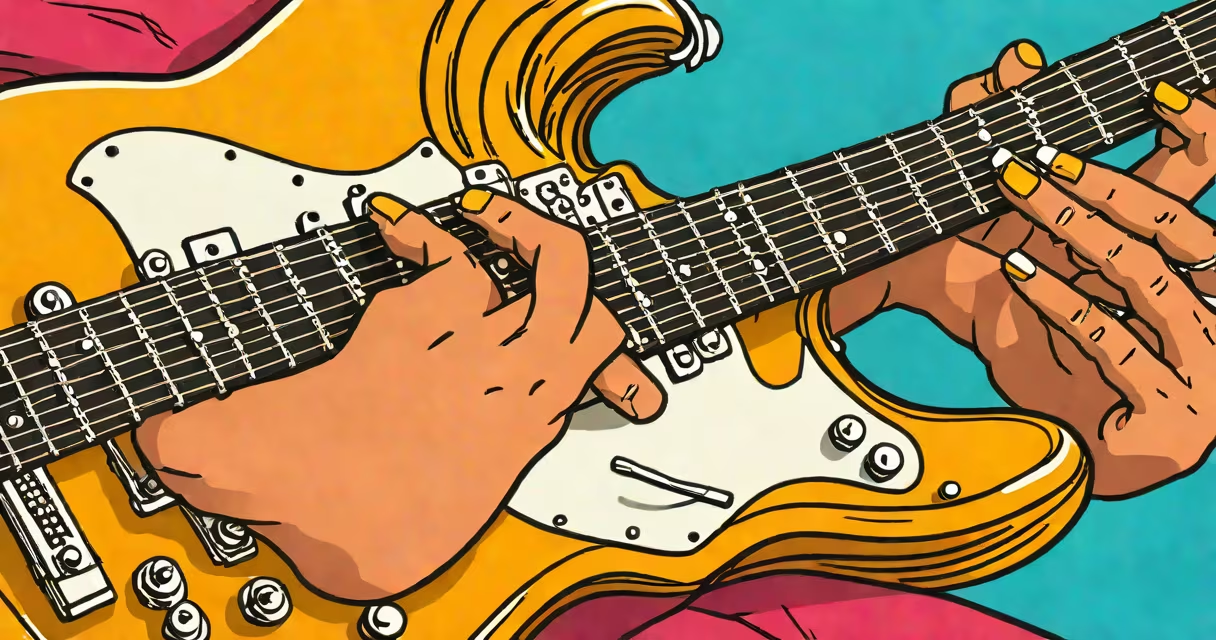
The "h" in guitar tabs stands for hammer-on, a technique where you strike a note by slamming your finger down onto a higher fret without re-picking the string.
Hammer-ons create smooth, connected notes without the need to pick each one. They're essential for fluid phrasing in rock, blues, country, and fingerstyle music. A single "h" between two numbers-like 3h5-means you play the first note by picking it, then quickly press your finger down on the second note's fret.
This technique reduces picking fatigue and adds expressiveness. For example, in a C major scale run (3h5 5h7 7h8), you pick the 3rd fret, then hammer to the 5th, then to the 7th, and finally to the 8th-all with one pick stroke. The result is a clean, legato sound.
When you perform a hammer-on, you don't pluck the string again. Instead, you use the strength of your fingertip to press the string down firmly against the fret. This increases the string's tension, raising the pitch to the desired note.
For a successful hammer-on, your finger must land precisely on the correct fret and make contact with the string at the right spot-just behind the fret wire. If you hit too far back, the note won't ring. If you hit too far forward, you risk muting adjacent strings.
Timing matters. A slow hammer-on sounds disconnected. A fast, clean one blends smoothly into the previous note. Practice slowly at first, focusing on accuracy and consistency.
Guitar tablature uses "h" to indicate a hammer-on. You'll see it written between two fret numbers: 5h7. This means "play the 5th fret, then hammer-on to the 7th."
Some tabs use multiple h's in sequence: 3h5h7. This means you play the 3rd fret, hammer to the 5th, then hammer again to the 7th-all in one motion. These sequences are common in melodic runs and solos.
Tablature may also combine hammer-ons with pull-offs (denoted by "p"). For example: 5h7p5. You pick the 5th fret, hammer to the 7th, then pull off to return to the 5th. This creates a quick, flowing effect often used in blues licks.
| Symbol | Meaning | Example |
|---|---|---|
| h | hammer-on | 3h5 = pick 3, hammer to 5 |
| p | pull-off | 5p3 = pick 5, pull off to 3 |
| h | multiple hammer-ons | 3h5h7 = pick 3, hammer to 5, then to 7 |
Hammer-ons appear in nearly every genre of guitar music. In blues, they're used to mimic vocal inflections. In rock, they add drive to riffs. In fingerstyle, they allow complex melodies to be played with minimal picking.
A classic example is the intro to "Hotel California" by the Eagles. The descending arpeggio in the verse uses hammer-ons and pull-offs to create a smooth, flowing texture. Without them, the passage would feel choppy and less expressive.
Hammer-ons are especially useful in fast passages. For instance, in a D minor pentatonic run (5h7 7h9 9h10), you pick the first note and hammer through the rest. This saves time and energy compared to picking each note individually.
Many beginners think "h" means "hold" or "harmonize." That's incorrect. "h" specifically refers to the physical action of hammering down. Confusing it with "hold" leads to poor timing and inconsistent volume.
Another mistake is attempting hammer-ons on the wrong string. On lower strings (E, A, D), the string thickness makes hammer-ons harder to execute cleanly. On higher strings (G, B, e), the thinner gauge allows easier execution. Always practice on the appropriate string for the intended effect.
Some players try to hammer-on using their nail. This causes a dull, muted sound. Use the pad of your fingertip-not the nail-to ensure full contact with the string. The pad provides better control and clearer tone.
Consider the opening riff of Deep Purple's "Smoke on the Water." The tab reads:
e|------------------|
B|--------3h5--------|
G|----3h5------------|
D|--5h7--------------|
A|------------------|
E|------------------|
Here, the G string plays 3h5 (3rd fret to 5th), then the D string plays 5h7. You pick the 3rd fret on the G string, hammer to the 5th, then move to the D string and pick the 5th fret, hammer to the 7th. The hammer-on creates a smooth, ascending lift in the melody.
Without the "h," the riff would require constant picking. With it, the player achieves a changing, expressive sound using minimal effort.
I once struggled with hammer-ons during a live performance. My fingers were too slow, and the notes didn't ring out. After practicing with a metronome at 60 BPM, gradually increasing speed, I noticed a clear improvement in timing and clarity.
Start by isolating the hammer-on motion. Play a single note, then practice hammering to a higher fret without picking. Focus on finger placement and force. Once consistent, integrate it into small musical phrases.
Use a tuner to verify pitch accuracy. If the hammered note is sharp or flat, adjust finger pressure or position. A well-executed hammer-on should match the pitch of a picked note.
"h" does not mean "hold" or "repeat." It's not a substitute for a sustained note. It's a specific motion-one that changes pitch instantly via finger pressure.
Also, "h" doesn't imply volume change. A hammer-on should maintain the same changing level as the original note. If the hammered note is quieter, you're likely pressing too lightly or missing the string's center.
Some tabs use "h" to indicate a harmonic. That's incorrect. Harmonics are marked with "o" or "[ ]" around the fret number. Using "h" for harmonics confuses readers and leads to errors in performance.
The "h" in guitar tabs means hammer-on-a technique where you press a finger down on a higher fret without re-picking. It enables smooth, connected notes and is used widely across genres. Understanding this symbol improves both reading accuracy and playing fluency.