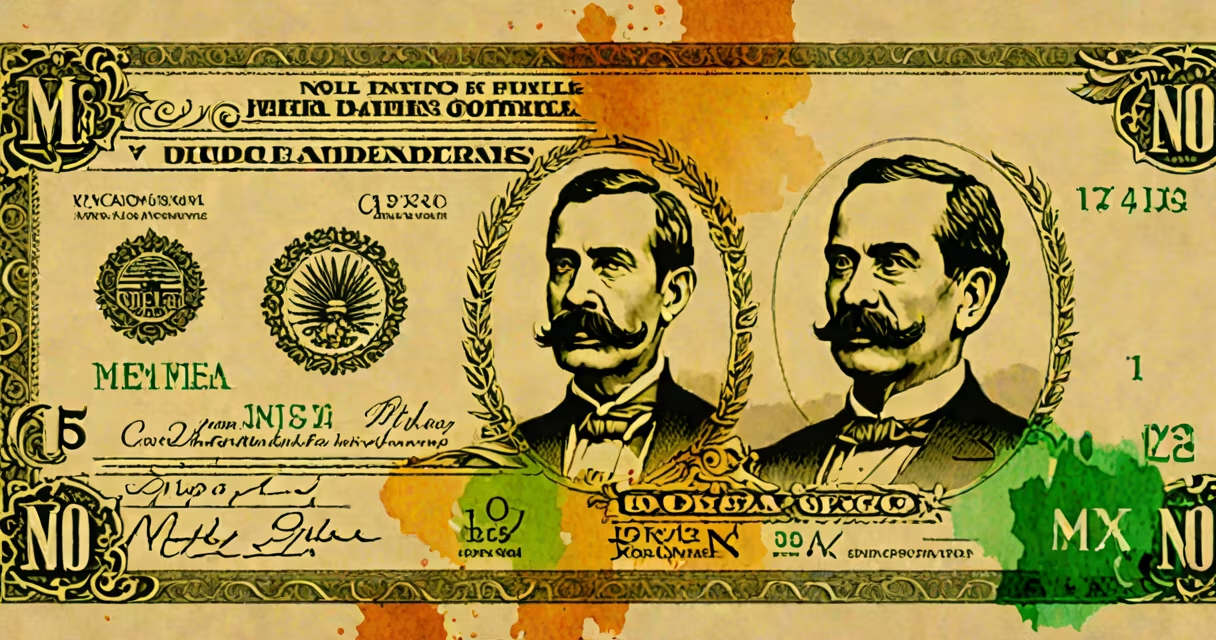
Mxn is the ISO 4217 three-letter code for the Mexican peso, the official currency of Mexico. It represents a unit of value used in domestic trade, international finance, and cross-border remittances.
The code appears in financial systems worldwide, including banking platforms, currency converters, and forex trading tools. For example, when you see "MXN/USD" on a trading site, it refers to the exchange rate between the Mexican peso and the US dollar.
Each country's currency has a unique three-letter code assigned by the International Organization for Standardization (ISO). MXN was established in 1999 and replaced the older "MXP" code, which was used until 1993 when Mexico reformed its monetary system.
MXN functions as legal tender within Mexico. It is issued by the Banco de México, the nation's central bank, and regulated under federal law. Transactions in pesos occur through banks, ATMs, mobile payment apps, and retail stores.
Internationally, MXN is traded on foreign exchange (forex) markets. Major currency pairs include USD/MXN, EUR/MXN, and JPY/MXN. These pairs reflect how much one unit of the US dollar, euro, or Japanese yen buys in Mexican pesos.
For instance, if the USD/MXN rate is 18.25, one US dollar exchanges for 18.25 Mexican pesos. This rate fluctuates daily based on economic indicators such as inflation, interest rates, and political stability.
Physical MXN currency includes both coins and banknotes. Coins come in denominations of 1, 2, 5, 10, and 20 pesos, while banknotes exist in 20, 50, 100, 200, 500, and 1,000 peso values.
Banknotes feature portraits of national heroes. The 20-peso note shows Benito Juárez, a former president and advocate for civil rights. The 1,000-peso note features Frida Kahlo, the iconic painter whose image symbolizes Mexican cultural identity.
| Denomination | Common Name | Portraits on Note |
|---|---|---|
| 20 | Twenty-peso bill | Benito Juárez |
| 50 | Fifty-peso bill | Porfirio Díaz |
| 100 | Hundred-peso bill | Emilio Portes Gil |
| 200 | Two-hundred-peso bill | José María Morelos |
| 500 | Five-hundred-peso bill | Francisco I. Madero |
| 1,000 | One-thousand-peso bill | Frida Kahlo |
These notes also include security features like watermarks, microprinting, and color-shifting ink. The Banco de México reports that counterfeit rates dropped below 0.03% in 2022 due to enhanced anti-fraud measures.
MXN is used in everyday commerce across Mexico. It powers retail sales, utility payments, wages, and government budgets. Over 120 million people rely on it daily, making it one of the most widely circulated currencies in Latin America.
International users encounter MXN in remittance flows. In 2023, Mexico received $60.4 billion in remittances from abroad, mostly from the United States. Most of these funds were sent in USD and converted into MXN through licensed providers like Western Union and MoneyGram.
Businesses engaged in cross-border trade often quote prices in MXN when dealing with Mexican clients. A US-based software company selling SaaS subscriptions to a Mexican firm may list the price in MXN to avoid exchange rate confusion and improve customer trust.
MXN is sometimes mistaken for "Mexican dollars," but Mexico does not use the term "dollar." The correct term is "peso." The US dollar is known as "dólar americano" in Spanish, while the peso is distinct in both name and value.
Another error is assuming MXN is interchangeable with other regional currencies. While neighboring countries like Guatemala and El Salvador use their own currencies (GTQ and SVC), they do not accept MXN as legal tender. Exchange rates differ across borders.
A lesser-known fact: MXN is not a floating currency in all contexts. The Mexican government maintains a managed float system, where the central bank intervenes during extreme volatility. This differs from fully free-floating currencies like the US dollar or euro.
Suppose you're traveling to Mexico City and want to convert $100 USD into MXN. On a typical exchange day, the USD/MXN rate is 18.45.
To calculate the amount in pesos:
$100 × 18.45 = 1,845 MXNThis conversion happens automatically at airports, hotels, or authorized exchange offices. However, fees and spreads can reduce the actual amount received. Some providers charge a 3% fee, reducing the final payout to 1,789 MXN.
When planning trips or managing business finances, always check live rates and compare provider fees. Tools like XE.com or OANDA offer real-time data and historical charts to track fluctuations.
Understanding what MXN means is essential for anyone involved in international finance, travel, or business with Mexico. It is not just a symbol-it's a functional, regulated currency with real-world impact.
Knowing what MXN means enables accurate budgeting, informed decision-making, and clearer communication across borders.