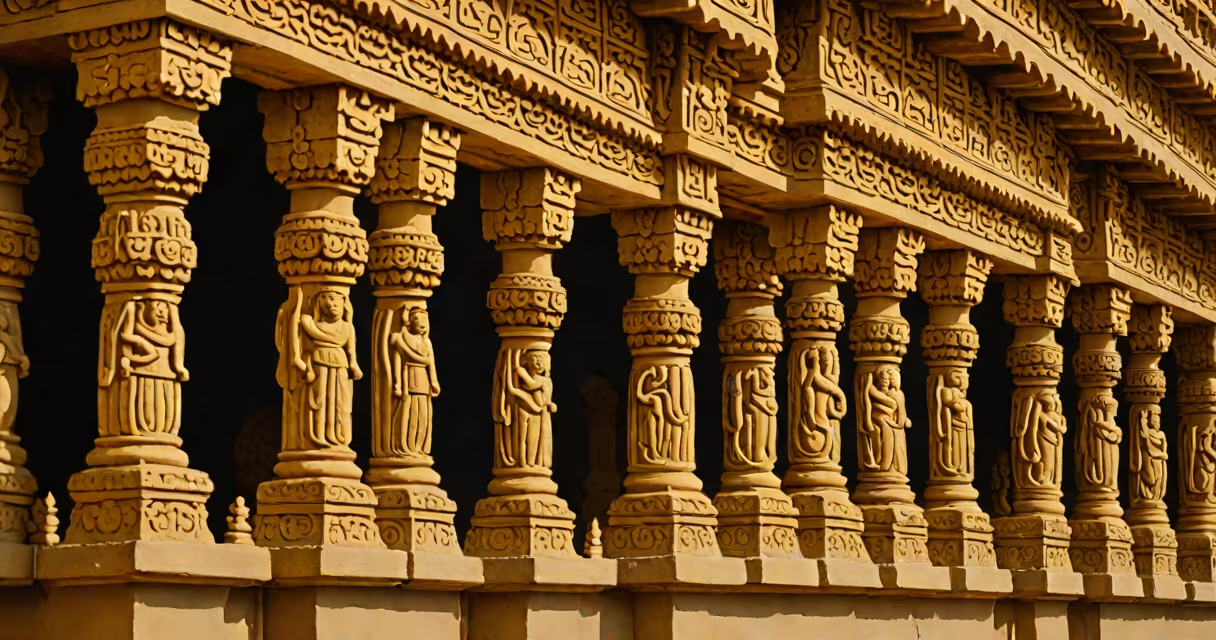
Jagdish Temple Udaipur is a 17th-century Hindu temple dedicated to Lord Vishnu, located in the heart of Udaipur, Rajasthan. Built in 1620 CE under Maharana Jagat Singh I, it blends Rajput and Mughal architectural influences with finely detailed stone carvings and a symmetrical layout.
The temple stands within the old city's walled core, near the City Palace and Lake Pichola. Its location makes it a central stop on Udaipur's cultural circuit. Unlike many temples in India, Jagdish Temple was constructed during a period of relative peace between Rajput rulers and the Mughal Empire, which influenced its design with subtle Mughal motifs alongside traditional Rajasthani elements.
Architectural historians note that the temple's foundation stones were laid using a unique mortar mix of lime, crushed stone, and cow dung-a technique still visible in the base structure. This method enhanced durability against monsoon erosion, a critical factor in the region's climate.
Jagdish Temple operates as both a functioning place of worship and a tourist site. Daily rituals begin at 5:30 AM with the *pratah-sandhya* (morning offering), followed by *aarti* at sunrise. Devotees light oil lamps while priests chant verses from the Vishnu Purana.
The temple complex includes a central sanctum (*garbhagriha*) housing a black stone idol of Lord Vishnu in a reclining posture. Surrounding this are four smaller shrines dedicated to Hanuman, Shiva, Durga, and Ganesha. The inner walls feature bas-relief carvings of mythological scenes, including the Ramayana's battle at Lanka and Krishna's leela with the gopis.
Visitors enter through a towering *shikhara* (spire) that rises 30 meters above ground. The spire's 12-tiered design follows the *Nagara* style, common in northern Indian temples. Each tier narrows slightly, creating visual balance. The outer walls are covered in 1,200+ individual stone panels depicting gods, animals, and celestial beings.
The temple's primary material is pink sandstone quarried from nearby hills. This stone weathers slowly and develops a rich patina over time. The roof tiles are made of terracotta, shaped by hand and fired in kilns using wood and cow dung fuel-traditional methods unchanged since the 17th century.
Three distinct structural zones define the temple:
Unlike many temples in North India, Jagdish Temple lacks a large courtyard. Instead, it uses a series of interconnected corridors and small courtyards to manage foot traffic during festivals. This design prevents overcrowding and maintains ritual privacy.
Jagdish Temple serves as a daily center for Hindu worship and hosts major religious events. The most significant is the annual *Shravan Mela*, held during the monsoon month of Shravana (July-August). Over 10,000 devotees visit during this time, participating in water offerings and night-long prayers.
It also functions as a cultural landmark. The Udaipur Municipal Corporation sponsors weekly classical music concerts in the mandapa during winter months. These events attract tourists and local artists alike, blending spirituality with performance art.
For travelers, the temple is a key stop on guided heritage walks. Entry fees are ₹50 for adults and ₹25 for children. Photography is permitted in public areas but not inside the sanctum. Visitors must remove footwear before entering the inner chambers.
Many assume Jagdish Temple is older than it is. Some sources incorrectly cite a 15th-century origin based on vague inscriptions. However, epigraphic records from the Archaeological Survey of India confirm construction began in 1620 CE and was completed in 1630.
A frequent error is confusing Jagdish Temple with the Jagannath Temple in Puri. While both honor Vishnu, Jagdish Temple's iconography is rooted in Vaishnavism's regional traditions in Rajasthan, not the Odia-centric practices seen in Puri. The Udaipur temple's deity is specifically associated with the *Dharmarajya* lineage of kings, linking it to royal patronage.
Another misconception is that the temple's design reflects pure Mughal influence. In reality, the Mughal elements-such as arched doorways and floral inlays-are limited to decorative features. Structural integrity remains firmly in the Rajput tradition, with load-bearing pillars and stone vaulting typical of the region.
On a typical weekday morning, a group of five tourists arrives at 8:15 AM. They pay ₹50 each at the gate and leave shoes in a wooden rack. Inside, they walk through the mandapa, where a priest performs *dhwaja pradakshina*-circling the flagpole three times.
At 9:00 AM, a family from Mumbai offers *kheer* (rice pudding) to the deity. The priest accepts it with a bow and places it on a silver platter. Later, a group of schoolchildren from Jaipur visits during a field trip. Their teacher explains that the 12 stone lions flanking the entrance represent the 12 zodiac signs in Hindu cosmology.
By noon, the temple's security team conducts a sweep of the grounds. They check for loose tiles and verify that no unauthorized materials are brought into the inner sanctum. All visitors are required to pass through a metal detector, a rule enforced since 2018 following a minor incident involving a hidden camera.
I visited Jagdish Temple during Diwali in 2022. The air vibrated with chants and the scent of incense. As the sun set behind the Aravalli Hills, the temple's stone façade glowed amber. I watched a young boy place a marigold garland on the deity's feet-his mother whispered a prayer in Rajasthani. The moment felt quiet, personal, and deeply rooted in tradition.
Despite its prominence, Jagdish Temple is not listed among UNESCO's World Heritage Sites. It is, however, protected under India's Ancient Monuments and Archaeological Sites and Remains Act (AMASR), 1958. The state government funds annual restoration work, including cleaning the spire and repairing damaged carvings.
One non-obvious fact: the temple's main entrance faces east, but the *garbhagriha* is oriented toward the northeast-a deliberate alignment believed to improve spiritual energy flow according to Vastu Shastra principles.
| Feature | Jagdish Temple Udaipur | Comparison Point |
|---|---|---|
| Construction Date | 1620-1630 CE | Chaturbhuj Temple, Gwalior (12th century) |
| Primary Deity | Vishnu (in reclining form) | Shiva (in lingam form) at Kashi Vishwanath Temple |
| Architectural Style | Rajput-Nagara with Mughal ornamentation | Dravidian at Meenakshi Temple, Madurai |
| Annual Visitors | ~150,000 | ~3 million at Tirupati Balaji Temple |
Jagdish Temple Udaipur remains a living monument-where centuries-old devotion meets modern tourism. Its enduring presence reflects the resilience of cultural identity in a changing world. For those seeking spiritual insight or architectural wonder, it offers a rare glimpse into Rajasthan's layered past.