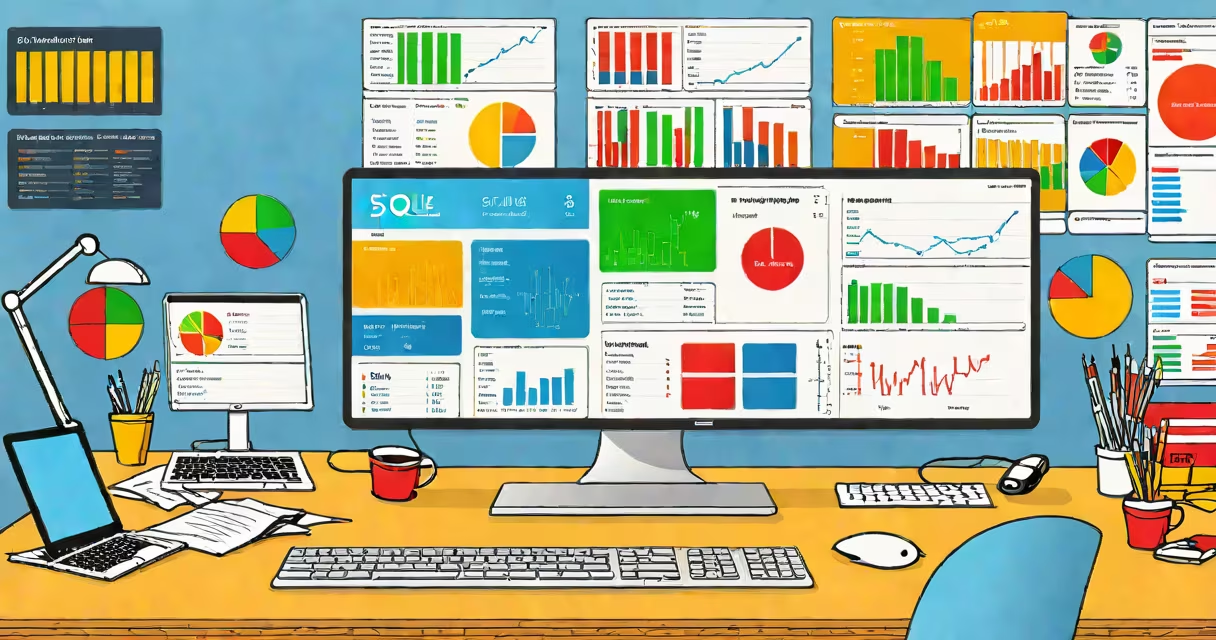
SQL meaning in business refers to the use of Structured Query Language to extract, manipulate, and analyze data that supports operational efficiency, financial forecasting, and strategic planning. It is the standard language for managing relational databases, allowing users to retrieve specific insights from large datasets.
Businesses rely on SQL to turn raw data into actionable intelligence. For example, a retail company uses SQL to pull daily sales figures by region, product category, and time of day. This enables managers to adjust inventory levels, identify high-performing products, and forecast demand. Without SQL, extracting such insights would require manual sorting across spreadsheets-time-consuming and error-prone.
SQL is not a single tool but a standardized language implemented across platforms like MySQL, PostgreSQL, Oracle Database, and Microsoft SQL Server. Its syntax remains consistent across systems, making it portable across different environments. This consistency allows teams to share queries and reports across departments, ensuring alignment in data interpretation.
At its core, SQL processes commands through a client-server model. A user sends a query via a client application-such as a business intelligence tool or a custom dashboard-to a database server. The server parses the command, accesses the relevant tables, performs calculations, and returns results in seconds.
For instance, a marketing team might run a query to find customers who made purchases within the last 30 days but haven't opened recent email campaigns. The SQL command filters records based on date ranges and engagement status. The result identifies a segment for targeted outreach, improving campaign conversion rates.
Each SQL statement follows a logical structure: SELECT specifies the data to return, FROM names the source table, WHERE applies filters, GROUP BY organizes results by category, and ORDER BY sorts them. These clauses can be nested and combined to handle complex conditions. A single query can summarize thousands of transactions in milliseconds.
Businesses apply SQL in distinct functional areas. The most common applications include reporting, performance monitoring, customer segmentation, and financial analysis.
| Use Case | Common Query Purpose | Example Output |
|---|---|---|
| Monthly Sales Reports | Aggregate revenue by product, region, and salesperson | Top 5 products by revenue in Q2: Product A ($125K), Product B ($98K) |
| Customer Churn Analysis | Identify inactive users based on login frequency and purchase history | 12% of users haven't logged in since March; 68% of those were in the 18-24 age group |
| Inventory Replenishment | Flag low-stock items and trigger restocking alerts | Item #X789 has 3 units left; reorder threshold is 10 |
| Employee Performance Tracking | Compare sales targets against actuals across teams | Sales rep Jane Doe exceeded quota by 15% in April |
These queries often run automatically via scheduled jobs. A finance department may have a nightly job that runs a SQL script to calculate month-end revenue, update dashboards, and send summaries to executives. This automation reduces human error and ensures timely access to accurate data.
Many assume SQL is only for IT professionals or data scientists. In reality, business analysts, marketers, and finance managers use SQL daily. Tools like Tableau, Power BI, and Looker allow non-technical users to write SQL through visual interfaces. These tools generate SQL behind the scenes, enabling users to explore data without coding.
A frequent misconception is that SQL requires advanced programming skills. While complex queries can involve joins, subqueries, and window functions, basic business queries use only SELECT, FROM, and WHERE. A simple query like SELECT * FROM sales WHERE date >= '2024-01-01' retrieves all sales from January onward-no expertise needed.
Another correction: SQL is not synonymous with "database." SQL is a language; databases are storage systems. You can store data in Excel, JSON files, or cloud buckets-but only databases support SQL. A company might store customer data in a CSV file, but to analyze it using SQL, they must import it into a database system like SQLite or Amazon Redshift.
In 2023, a SaaS company noticed a 14% drop in user sign-ups over three months. The marketing team used SQL to investigate. They ran a query joining the users table with the events table to track actions taken during the free trial period.
SELECT u.user_id, u.sign_up_date, COUNT(e.event_type) AS event_count
FROM users u
JOIN events e ON u.user_id = e.user_id
WHERE u.plan_type = 'free'
  AND u.sign_up_date BETWEEN '2023-04-01' AND '2023-06-30'
GROUP BY u.user_id, u.sign_up_date
HAVING COUNT(e.event_type) < 5;
The query returned 1,247 users who signed up but completed fewer than five onboarding steps. Further analysis showed that 78% of these users abandoned the platform within 48 hours. The team redesigned the onboarding flow, added tooltips, and reduced required steps from 12 to 6. Within two months, sign-up conversion improved by 22%.
This case illustrates how SQL transforms vague concerns into measurable problems. Without querying the data, the issue might have remained hidden in aggregated reports.
SQL is often confused with spreadsheet formulas or business intelligence tools. While both can analyze data, SQL operates on structured databases and scales to millions of rows. Spreadsheets struggle beyond 100,000 rows due to memory limitations. A pivot table in Excel may take minutes to refresh a dataset of 500,000 rows; the same task in SQL takes seconds.
Also, SQL is not the same as benchmarking. Benchmarking meaning in business involves comparing performance metrics against industry standards or past results. SQL supports benchmarking by retrieving the necessary data-but it doesn't define the comparison structure. For example, a company might use SQL to extract its average customer response time, then compare it to a published industry benchmark.
Similarly, while business address meaning relates to location identification, SQL can be used to geocode addresses and analyze regional performance. A logistics firm might use SQL to join delivery records with ZIP code data, identifying zones with delayed shipments. This insight leads to route optimization, reducing fuel costs and improving service levels.
Business revenue meaning depends on accurate data capture and calculation. SQL ensures consistency by defining revenue as quantity_sold * unit_price across all records. This prevents discrepancies caused by manual entry or inconsistent formatting in spreadsheets.
I once worked with a small e-commerce startup where the founder insisted on relying on Google Sheets for sales tracking. After a quarter, discrepancies emerged between reported revenue and bank deposits. I wrote a SQL script to reconcile the data by joining the orders table with payment logs. The query revealed 17 duplicate entries and 32 missing payments-errors that had gone unnoticed for months. Once corrected, the business adjusted its cash flow projections and avoided a funding shortfall.
This experience confirmed that SQL isn't just for large enterprises. Even small teams benefit from structured data handling. The ability to validate numbers quickly prevents costly mistakes.
Understanding SQL meaning in business is essential for anyone involved in data management, strategy, or operations. It enables transparency, accuracy, and speed in decision-making. planning budgets, SQL provides the foundation for reliable insights.