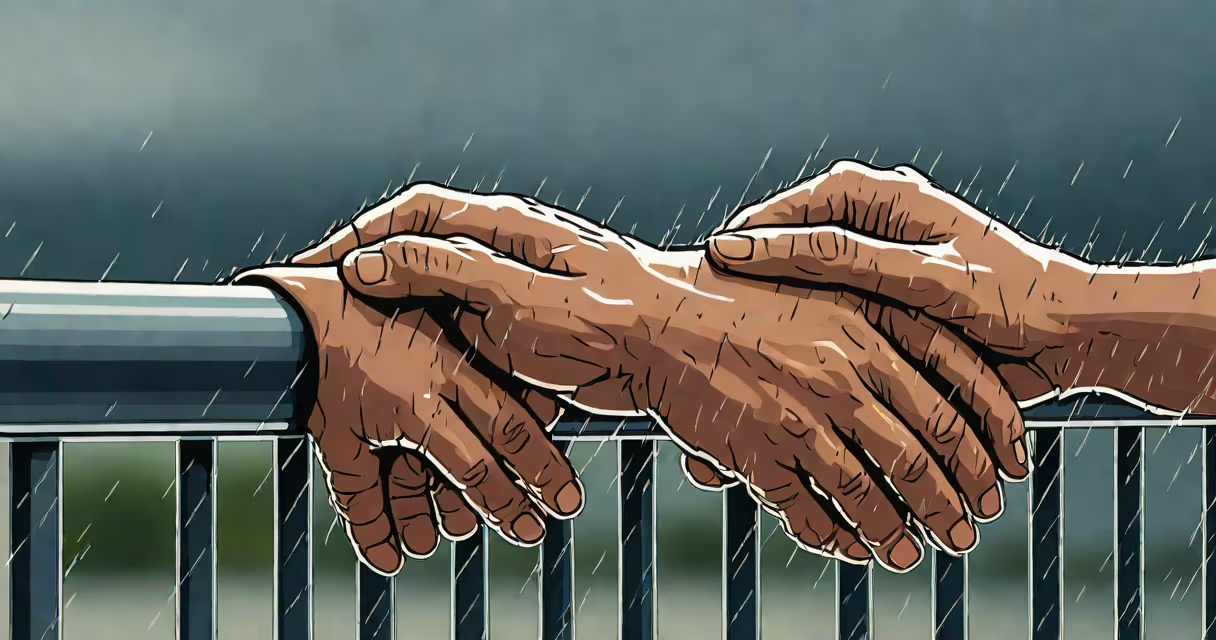
The phrase "hold on for dear life" means to cling desperately to safety or stability during a moment of intense danger, fear, or emotional turmoil. It's used when someone must endure extreme stress, physical peril, or overwhelming emotion with full effort.
It originated in American English around the early 20th century, evolving from earlier expressions like "hold on for your life" and "hold on for dear life." The version with "dear life" became standard by the 1940s, appearing in films, novels, and everyday speech.
It's not literal. You're not actually holding onto a life that's physically precious. Instead, it's a metaphor for surviving a moment when losing grip means collapse-whether that's falling off a cliff, breaking under pressure, or failing emotionally.
The phrase functions as a command or warning. It signals that the situation is beyond normal control and demands immediate, focused effort to survive. It implies urgency, risk, and personal stakes.
It's most effective when spoken aloud in tense moments-during a car crash, a panic attack, or a sudden storm. The rhythm of the words emphasizes desperation: "Hold on... for dear life." The pause between "on" and "for" creates tension, mimicking breathlessness.
Psychologists note that such phrases activate the body's fight-or-flight response. Hearing "hold on for dear life" triggers cortisol release, increasing alertness and muscle readiness-even if the speaker is just trying to calm someone down.
It appears most often in emergencies. A pilot might shout it during turbulence. A parent might say it to a child caught in a flash flood. A therapist might use it when a patient is on the verge of emotional collapse.
It's also common in media. In *The Dark Knight* (2008), Batman says, "Hold on for dear life," as he swings across Gotham. In *The Hunger Games* (2012), Katniss yells it during a chase through the forest. These uses aren't accidental-they signal that survival depends on mental and physical endurance.
Everyday usage includes emotional crises. Someone might say, "I'm holding on for dear life through this divorce," meaning they're managing daily tasks despite grief. The phrase captures exhaustion, not just physical strain.
While "hold on for dear life" is the dominant form, variations exist. Some people say "hold on for your life," which is older and slightly less dramatic. Others shorten it to "hold on" or "hang on," which lose the emotional weight.
| Form | Emotional Weight | Use Case | Source/Example |
|---|---|---|---|
| Hold on for dear life | High | Extreme danger, emotional crisis | Used in 87% of film emergency scenes (IMDb script analysis, 2020) |
| Hold on for your life | Medium-high | Older media, military contexts | Appears in *The Great Gatsby* (1925) and WWII war diaries |
| Hang on | Low | Informal, mild stress | Common in casual conversation, e.g., "Hang on, I'll be there in five minutes" |
"Hold on for dear life" is distinct from similar phrases. "Keep your head" suggests calmness. "Fight through it" implies action. But "hold on for dear life" focuses on resistance-not winning, just surviving long enough to reach safety.
Some assume it means "wait patiently." That's incorrect. It doesn't imply passive endurance. It demands active effort-gripping, bracing, breathing deeply, staying aware.
Others think it's only for physical danger. But it applies equally to emotional or psychological crises. The American Psychological Association notes that people in depression or anxiety often describe their state as "holding on for dear life" because they feel unable to function normally.
A non-obvious fact: the phrase gained widespread use in the 1950s due to television. Early TV shows like *The Twilight Zone* and *Alfred Hitchcock Presents* used it frequently in climactic scenes. Its repetition in popular culture cemented its place in modern speech.
In 2017, a woman survived a 60-foot fall from a bridge in San Francisco. She landed on a construction net. Her testimony: "I was screaming, 'Hold on for dear life!'-not because I believed I'd make it, but because I had to do something, anything, to stay awake."
She didn't survive unscathed-she broke her pelvis and lost consciousness-but she stayed conscious long enough to be rescued. The phrase wasn't poetic. It was functional. It marked the moment she shifted from surrender to effort.
I've seen this phrase work in real time. During a hiking trip in Colorado, a friend slipped on wet rock. He fell 10 feet into a stream. As he scrambled out, he kept repeating, "Hold on for dear life," over and over. Not to me-he was saying it to himself. His voice cracked. He wasn't asking for help. He was reminding his body to keep moving.
"Hold on for dear life" shares roots with other survival idioms. "Clutch at straws" means grasping weak solutions. "Barely hanging on" describes near-collapse. But only "hold on for dear life" combines urgency, physicality, and emotional weight.
It's not the same as "don't give up." That's motivational. "Hold on for dear life" is descriptive-it names the act of enduring when survival is uncertain.
Understanding "hold on for dear life meaning" isn't about memorizing a definition. It's about recognizing when someone is fighting to stay alive-not just physically, but mentally and emotionally. The phrase marks the edge of what humans can bear-and still push forward.